Health problems arise despite the best efforts of the patient and health care providers, but personality may influence the outcome. Self-awareness and self-management may enhance conflict management when variance and conflict mean a state or condition marked by a lack of agreement or harmony [1]. Five modes of behaviour – competing, collaborating, compromising, avoiding and accommodating – are frequently used in difficult health situations [2,3]. Overuse of one of these behaviour modes may lead to resolution failure, dissatisfaction and poor health outcomes [4,5].
There are many models that can be used to resolve challenges. Some experts feel personality style may be more important than the problem itself [5]. The Thomas-Kilmann conflict model defines the five modes of behaviour to explore incongruent opinions:
Competing – “If I’m involved in conflict, I want to be in charge”
Compromising – ”Let’s look for middle ground; if everyone gives in a little, we’ll have a speedy settled solution”
Collaborating – “Let’s take the time to put our heads together find a solution everyone likes”
Avoiding – conflict is ignored or stalled, “I don’t want to be involved”
Accommodating – “I’ll just give in, it’ll save further problems” [3,6].

The degree of assertiveness and cooperativeness further influences the five personality style modes: my way, halfway, our way, no way and your way [7].
Patients with severe haemophilia B, an inherited bleeding disorder, lack a protein necessary to clot blood. Beginning in infancy, the patient’s health care provider and parents begin sharing the responsibility of managing this rare bleeding disorder. Joint bleeds cause patients to suffer acute pain and subsequent arthropathy [8]. Prophylactic factor IX treatment has changed the goal of haemophilia programs from an emphasis on treating life-threatening bleeds to a focus on managing chronic disease, including interventions to reduce the risk of long-term disability [9].
Case history
At the age of 19 years old, a Canadian man with haemophilia B was advised by an orthopaedic surgeon that he had the ankles of an 80-year-old man and ankle fusion would not be a possibility for seven years. Now, at 23 years of age, he has chronic haemophilic arthropathy in his right and left ankles. He is in receipt of disability benefits and lives with a roommate while finishing grade 12 high school. He plans to continue his education in social sciences.
Historically, after a bleed, he avoided using the clinic’s protocols of administering 1-2 follow-up factor IX doses and contacting the clinic when additional follow-up treatment doses were required. His fear of having further bleeds in his ankles caused him to self-prescribe follow-up factor IX treatments for 5-13 days. Despite advice and education from his health care providers, and being encouraged to telephone the clinic should he require additional follow-up treatments, the patient continued to over treat. The provision of information alone had little or no impact.
The patient’s behaviour began to change after he was asked to describe his prescribed treatment plan. Although not following the plan; he described it fully and accurately. On being asked about a treatment plan he envisioned would decrease bleeds and follow-up treatments, the young man compromised his wish to treat with recombinant factor IX 1500 units daily, and devised his own unique treatment plan of 1000 units daily (HCP plan) for 6 days with one weekend day of 3000 units (patient plan). The patient’s self-directed plan, approved by clinic physicians, went on to sustain a year of zero bleeds.
In May 2015, the patient suffered a bleed from accidental trauma to his left ankle. Despite prophylaxis, the arthropathic ankle bled again in October as a result of physical overuse. Because the pain did not resolve to weight bearing within 1-2 weeks, he limited his activities to home and used crutches or hopped about. By January 2016, significant muscle wasting had occurred in his left leg, including the beginning of a contracture in the left foot. He avoided discussing the severity of the situation when a factor order was placed. As he did not trust the effectiveness of his factor IX, he overused to the extent of 53 follow-up doses after the two left ankle bleeds. His belief that frequent and high doses of factor are the best treatment for bleeds causing pain for longer than 1-2 weeks was influenced by having been admitted to hospital for a month for a psoas bleed at 16 years old and receiving high and frequent doses of factor. He has deferred completing Grade 12 until his ankles are “better”.
Management and outcomes
Frequent follow-up appointments with the physiotherapist were arranged. Even though the patient had a trough of 5% on 1000 units daily, he still had breakthrough bleeds in 2015, thought to be attributed to (a) cycle of unresolved synovitis/inflammation and/or (b) possibly lower factor
IX penetration/distribution in the ankle. He was therefore switched to a trial of plasma-derived factor IX in January 2016 to see if it was more effective, and prescribed celecoxib 100 mg BID to reduce the inflammation and prevent rebleeding. At this stage, the patient avoided weight-bearing (Figure 1). He was also on the waiting list for a possible synovectomy.
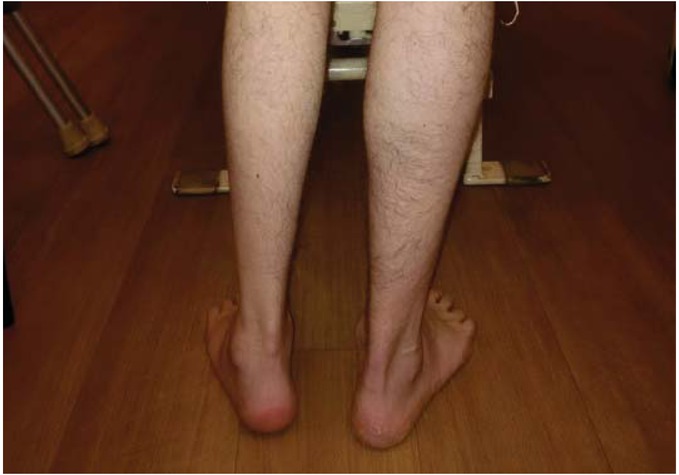
The patient explained that the physiotherapy strengthening exercises he was using to rebuild the muscles caused inflammation, but the celecoxib cooled the inflammation, preventing bleeds. This combination reverted muscle wasting to muscle building. In addition, the patient reported that he felt his ankle braces (introduced January to April 2016) provided support. He said: “I would use the braces for about 8 - 10 hours a day on the physio’s recommendation. She mentioned that even though primarily those braces are used for support, which is what I use them for on a daily basis, that it would also prevent my ankle from healing in a slouched position.” To date, plasma-derived factor IX has prevented further bleeds.
Discussion
Actively engaging the patient in his care has achieved the best results. The patient describes his awareness of his pain, activity and joint range of motion as helping him to self-manage his bleed rate. Using the experience of the patient and the expertise of the HCPs to actively support patient autonomy in all aspects of decisions related to haemophilia management, the British Columbia Hemophilia Adult Team approach de-emphasises “adherence” as the primary goal, and focuses on a prophylaxis plan that is customised by the patient and aligned with his priorities [10]. Gaining the patient’s insight and opinion promotes health change behaviour, empowering him to direct his care toward his desired outcomes.
When health challenges arose, our patient described his two personality styles as Avoiding and Compromising. Neither personality style is right or wrong, but it is helpful to detect the patient’s preferred personality style(s) and for the
health care providers to have insight into their personality behaviour mode(s) [11]. If the health care provider tends to be a collaborator and wants to discuss the problem at length with the patient, but the patient wants to use compromise to find middle ground or to simply avoid it, a collaborative approach could impair resolution [12]. Avoiding an issue may seem effective in the short-term, but is not a long-term solution. If overuse of avoidance gradually weakened the left ankle, then the overuse of a particular personality style may weaken efforts to manage the problem.
Each of the five personality styles can be effective in the right circumstances; the key is not to overuse one or two preferred styles indiscriminately. Using all five styles appropriately, depending on the situation, enables a more balanced approach. Initially, the patient avoided weight-bearing for four months. However, he compromised, creating common ground with the health care providers, he was empowered to direct his care toward his desired outcomes. The patient reported that he was willing to follow the health care provider’s treatment plan for rehabilitation, but wanted control over the timeline to become weight-bearing without crutches (Figure 2).

Conclusion
It is important that haemophilia health care providers have awareness of multiple strategies to bring down barriers blocking optimum haemophilia health outcomes in patients who practice self-care. An awareness of personality styles may bring two sides together and promote a good working relationship to achieve optimum health outcomes.
Next steps
HCPs may have the skills to discern if a patient is competing, collaborating, compromising, avoiding or accommodating. However, are they aware of their own personality styles? Soft skills enhance collaboration and partnership between health care providers and others [11]. We plan to examine this further by inviting 120 haemophilia nurses to take part in a quality improvement research project. Some 30 Canadian nurses at their AGM and 80-100 from around the world at the WFH Congress in Orlando Florida in July 24, 2016 will be asked to complete a TKI questionnaire (Thomas-Kilmann Conflict Mode Instrument). This is a tool that will enable them to enhance their conflict management skills through self-awareness, by determining their most and least frequent behaviour modes in work relationships. The TKI questionnaire is a leading measure of conflict-handling modes that has been used in research for more than 40 years. This instrument has been used over four million times and has been featured in hundreds of research studies. The TKI CPP Inc website notes that the instrument is constantly reviewed and updated for differences on median TKI scores between men and women, as well as between ethnic groups, organizational levels, educational levels and are negligible in terms of practical importance.