Research is required to further the development of care for patients and their families, according to the authors of the European Principles of Haemophilia Care, published in 2008 [1]. They wrote that this research should include examination of different service delivery models, outcomes and quality of life measures; nurses were recognized as being key players in promoting this evidence. A survey published in 2012 found that UK haemophilia nurses demonstrated “an acceptance that care can be improved for patients and their families through implementing research into clinical care” [2]. Nevertheless, the survey found that few haemophilia nurses actually engaged in nurse-led research. Since then haemophilia nursing research has gained a greater profile within the published literature. Mostly research is qualitative in nature and focuses on patient outcomes and care; the published research is skewed towards the developed world, where affected individuals have relatively ready access to specialist care.

The World Federation of Haemophilia (WFH) nurses committee (WFHNC) is a subcommittee of the WFH that focuses on nurse education and training to enhance patient care and outcomes. This paper describes a project established by the WFHNC to understand how haemophilia nurses practice globally, their needs and requirements to augment their skills, and to investigate areas where nurses can enhance nursing and patient care through improved clinical practice using evidence-based care, particularly in those countries where there is limited access to diagnosis, factor concentrates and home therapy.
Methods
The WFHNC devised a questionnaire designed to explore the existing clinical experience, attitudes and barriers towards developing evidence-based care for haemophilia nursing globally. Invitations to a customisable web-based survey programme (SurveyMonkey) were sent by email to all haemophilia nurses known to the WFHNC. Instructions for completing the study were translated into numerous languages to facilitate wider uptake of the study. The questionnaire was translated into Portuguese and Chinese for nurses in Brazil and China who completed the study using a paper and pencil questionnaire. Responses to free text questions were then back translated into English and entered onto the SurveyMonkey database to ensure full data capture.
As well as answering multiple choice response questions on the SurveyMonkey, two distinct free-text questions were asked:
‘list up to 5 key areas in which you would like to see more haemophilia nursing education/support/research’ (clinical practice) and
‘please suggest up to 5 topics you would like to see covered in future WFH nurses meetings’ (evidence base/research practice).
Each comment was coded into a topic; the topics were then coded as recurring themes. For example ‘heavy menstrual bleeding’ and ‘managing haemophilia carriers’ were coded as a topic under the umbrella theme of ‘women with bleeding disorders’. The results of these two free-text questions overlapped, particularly where evidence-based care is limited, or where there are few publications to support clinical practice. This reflects a need to develop nurse-led strategies which answer these questions (see Table 1).
Table 1
Topics identified for improved clinical evidence and nurse-led research
Results
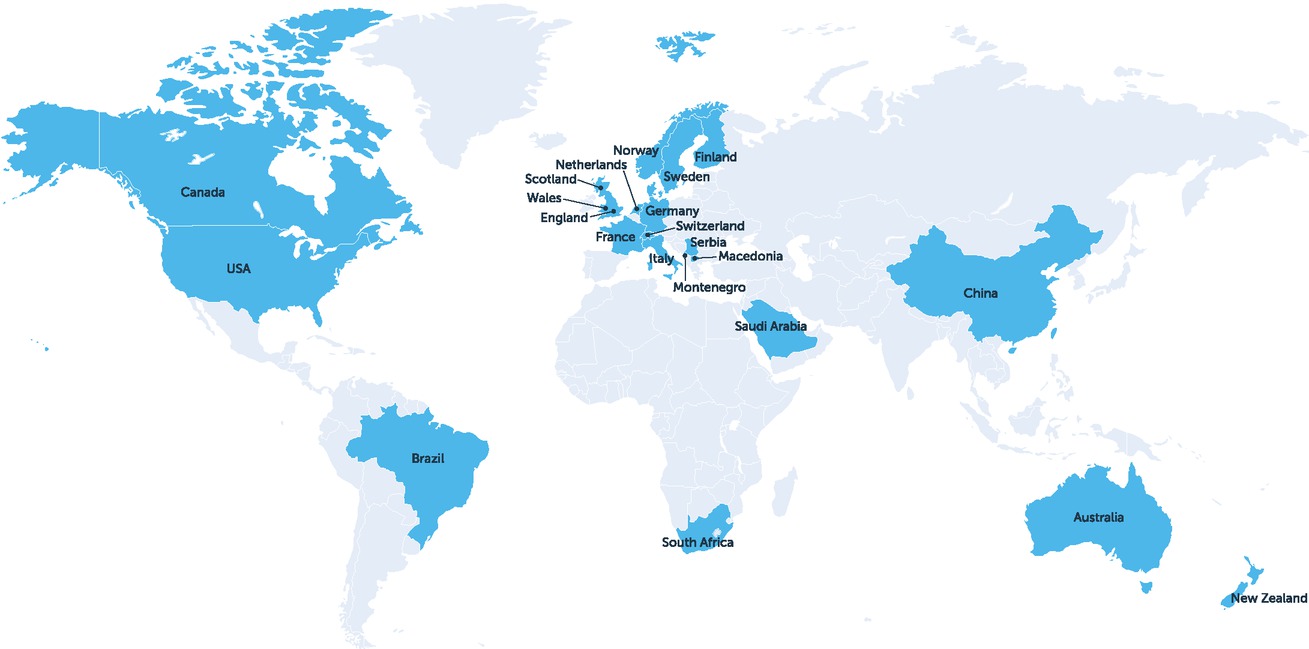
In all, 297 nurses from 22 counties (Figure 1) participated in the survey. These were established experienced haemophilia nurses, reporting a range from ≤ 5 years (n=113) to ≥ 20 years (n=51) as a practicing haemophilia nurse. Some 253 respondents reported having degree level education, with most reporting a BSc (n=152), MSc (n=56) or PhD (n=1) in nursing. A further 44 nurses reported having undergraduate to Doctoral degrees in other health-related fields. 36.6% of respondents reported that their institution required them to be registered nurses, a further 31.2% requiring a diploma, 33.5% a first degree, and 3.1% masters level education to practice in their role.
Nurses mainly worked in large haemophilia centres with 42.6% of respondents reporting treating more than 100 patients with haemophilia; only 5.2% treated ≤5 patients per year. Day-to-day activities were similar for nurses regardless of geographical location; these are listed in Table 2. Some nurses reported extended roles within both clinical care (e.g. nurse-led clinics and care delivery) and nurse-led research. While two-thirds (66.6%) administered clotting factor to patients, nearly one-third (29.0%) also prescribed it.
Table 2
Day-to-day responsibilities of haemophilia nurses
The majority of nurses (57%) worked full time in haemophilia care (31-40 hours/week) with 19.5% being funded to provide 1-10 hours haemophilia care per week. 20% of nurses reported having dedicated/funded non-clinical time for nurse-led research/enquiry. For some nurses’ this ‘academic time’ was rostered to facilitate nurse-led research; whilst others performed research in their clinical time. 83% of haemophilia nurses reported working an average of 1-≥ 10 additional hours per week for both clinical and academic reasons, and 50% of these nurses reported this time was not funded nor recouped.
Respondents identified 381 areas in need of improved evidence base and a total of 487 research questions. These were collated into 25 clinical and 29 research themes (Table 1). The top three themes in the clinical domains were:
products (n=37)
The top three research questions identified were:
Supporting nurses and nurse development in research role (n=60)
Managing and using new therapeutic products (n=57)
Child and adolescent care (self-management, adherence, transition (n=38)).
Communicating in English was identified as an issue that precluded nurses from participating in promotion of clinical and research care: 29.2% of respondents stated that writing was problematic; 28.6% cited difficulties in speaking in English, 24.3% cited difficulties reading English and 23.8% cited poor verbal understanding. This meant that many nurses never attended international meetings such as the WFH Congresses where they could present or hear about care given by nurses. Only 45% of respondents had ever attended the WFH congress and only 54% knew who was their regional WFH nursing committee member. While 45% of respondents stated they had attended WFH, 84% of these stated they had received study leave to attend international meetings. For 85% of respondents, funding was the main issue for not attending international meetings.
Discussion
This survey has highlighted many areas in the world where haemophilia nurses have an impact on direct face-to-face patient care, and are engaged in promoting nurse-led care to improve patient outcomes. That 46% of nurses do not know the identity of their regional WFH nursing committee member shows that the WFHNC has an opportunity to improve care even more by engaging with nurses within our regions. This may be particularly relevant in developing regions of the world, where support for nurses may be lacking.
It is accepted that research is required to further the development of care for patients and their families, and that this should include examination of different service delivery models, outcomes and quality of life measures.
Furthermore, nurses are recognized as being key players in promoting this evidence [1]. In the present survey, nurses across the world have identified similar areas of care that lack an evidence base and where nurse-led research could be undertaken to provide this evidence.
The high percentage of nurses educated to Baccalaureate degree level and beyond suggests that haemophilia nurses are well placed to impact day-to-day patient care. Nurses who are educated to degree level are known to have a positive impact on patient experience, outcomes and safety [3]. Advanced nursing practice, for example through supporting patients and families [4], promoting haemophilia care within hospital environments [5], delivering nurse-led clinics [6] is known to have a significant impact on patient care and outcomes [7]. Supporting development of haemophilia nurse advanced practice at an international level is possible through on-line nurse education, which is available in the United States of America [8]. A new Nursing Certification programme is now available in the United States as well which recognizes nurses who demonstrate expertise in hemostasis nursing through a portfolio submission [9]. Haemophilia nurse education and development in the UK has long been supported by an established competency framework [10] and there are currently moves underway to establish a standard curriculum for haemophilia nurses practicing within the European Union countries [11]. These frameworks include skills that are both generic and transferable (such as counselling and genetics) as well as haemophilia specific. To continue to develop the role of the nurse globally, the haemophilia nursing community needs to ensure that all nurses have access to accurate and current care and research data. Informed and educated nurses result in informed and educated patients. Together, this leads to improved patient experience and outcomes.
Conclusion
In the 2012 survey of UK nurses, it was reported that ‘integrating research into clinical practice is problematic across nursing regardless of seniority, role, educational level or nursing culture’ [2]. This study confirms that little has changed over the last four years, and that nurses struggle to incorporate research and evidence-based care into their day-to-day practice. What has changed significantly since 2012, is the recognition of haemophilia nurses as researchers who are able to support collaborative research locally, nationally and internationally. This is a key part of the haemophilia nurses remit and leads to improved care and better outcomes for patients and families affected by inherited bleeding disorders. This survey has demonstrated that nurses are willing and able to undertake nurse-led initiatives such as audit, service evaluation and research to enhance patient/family reported outcomes. The WFHNC is ideally placed to support this development through WFH outreach programmes, on-line education platforms and through on-going local support and education for nurses. Individually we can improve care for affected persons and their families, by sharing practice together we can improve care for many more.