“We love raising our children; but really, do you want your child with haemophilia at home when he’s 50 years old and unmarried? No. You want him out of the house and independent.” Laurie Kelley brings the same no-nonsense “tough love” approach to the individuals and organisations she works with in the developing world.
It was after the birth of her son in 1987 that Laurie became active in the US haemophilia community as an author and publisher of educational materials for families. By the mid-90s, with support from Bayer HealthCare, Laurie “went international” to help educate parents in developing countries where there was no haemophilia care. She soon realised that parents would be more receptive to learning about how to form campaigning non-profit organisations if they could get hold of clotting factor for their children. This led to the founding in 2002 of Project SHARE, a factor donation programme that collects unused or unwanted factor products from US treatment centres, pharmacies and patients and donates it to patients, doctors, clinics, and hospitals in countries where factor is scarce or unavailable. Project SHARE is a partnership between Laurie’s company (LA Kelley Communications, Inc.) and several pharmaceutical corporations that make products to treat haemophilia. It has now donated more than 70 million units of factor to patients in more than 70 developing countries.
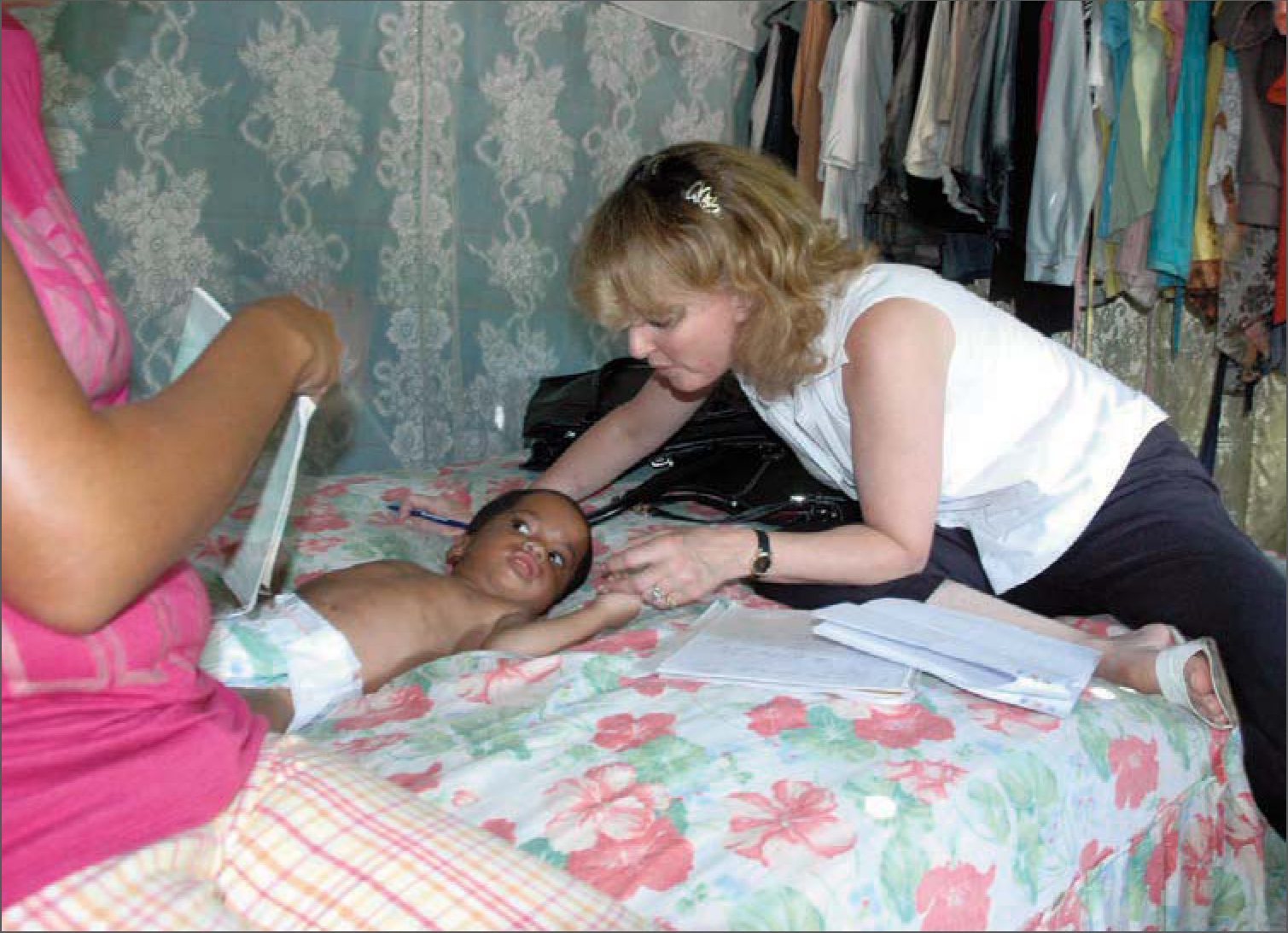
Laurie Kelley visits the impoverished home of baby Wilmer, who had a brain bleed and suffered from hydrocephalus, in the Dominican Republic
But it was in 2000, while Laurie was visiting a family with an eight-year old boy in Karachi, Pakistan, that the idea for Save One Life was born. “The father said, ‘School for him costs $20 a month and that’s how much I earn as a postal worker. With an extra $20 a month I could put him into school. He’s my eldest son; he’ll get a good job and will support the whole family’.”
Laurie established the child sponsorship programme to provide $20 a month directly to families with bleeding disorders in developing countries. “That was our key point: that the money raised would go directly to the families. So there was a direct one-to-one link between, say, a family in the US or the UK sponsoring a child with haemophilia in some place far away like Pakistan.”
Typically, these become long-term relationships, although it is for individual sponsors to decide whether they want to reveal who they are and establish a relationship. “We don’t routinely offer the sponsors’ information to the families as sometimes the families can abuse the privilege by begging for factor or more money. But we have had sponsors travel overseas for the first time, specifically to India, to go and meet their sponsored child; that’s a great experience.”
The goal is that the individual sponsors the child until he’s 18, but Laurie says they now have two new programmes: “One is an international scholarship programme to help pay for technical or academic training, the other is micro-grants to help patients start a small business. So it’s really turned into a lifecycle where we want to support them to age 18, if possible, get them into college or technical school, and if they succeed at that or even if they can’t do that, help set them up with a little business. We have now given thousands of dollars to help young men with haemophilia set up internet cafes or sell shoes on the roadside or become farmers. We try to keep people interested in getting these boys on their feet so that they can take care of themselves.”
In this way, she says, Save One Life is not just about charity but about changing mindsets. “It’s about using charity as a tool for individual growth and as a means of bringing two different worlds together – the developed world, where we have everything – and to offer people in the developing world a chance to build something.”
Save One Life has now helped over 1,100 children with haemophilia; some have gone to college, or now have their own jobs, businesses and families. Asked about her biggest success story, Laurie recalls one boy she met in India in 2005, who could not speak English and was very thin and impoverished. “Recently I was back in India and he walked up to me and I said, ‘What’s your name?’ and he said, ‘You know me.’ I replied, ‘I don’t think so.’ He told me his name and I couldn’t believe it. I did know him! He had been to college, speaks English, has a job in electrical engineering, and he is now supporting his family.”
She tells another story, of a young man she’d helped in India. “He told me, ‘I am now done with college; I am going to give my sponsorship to somebody else who needs it more than me.’ That was amazing because they recognise the need to help each other and sponsor each other.”
No limits for those who follow the rules
No countries are off limits where Save One Life is concerned, but Laurie says the countries in which they work need to be fairly stable with reliable communications as the charity is dealing with other people’s money, all of which has to be accounted for. “So we need documentation, we need profiles of the children filled out and submitted, and then we have to have wire transfers. So, for instance, we wire over $65,000 to India, and we have to track where all of that goes.”
In most countries, she prefers to work with established NGOs that have a track record, and that are accountable and transparent. “India was our first partner country because the Hemophilia Federation (India) is fantastic with transparency and accountability; it runs like a well-oiled machine. In India alone we have over 500 children. But we’re venturing out and taking some risks. We’d love to work in as many countries as possible. We will open the program up this year to Cambodia because they’re responsive and meet all our criteria.”
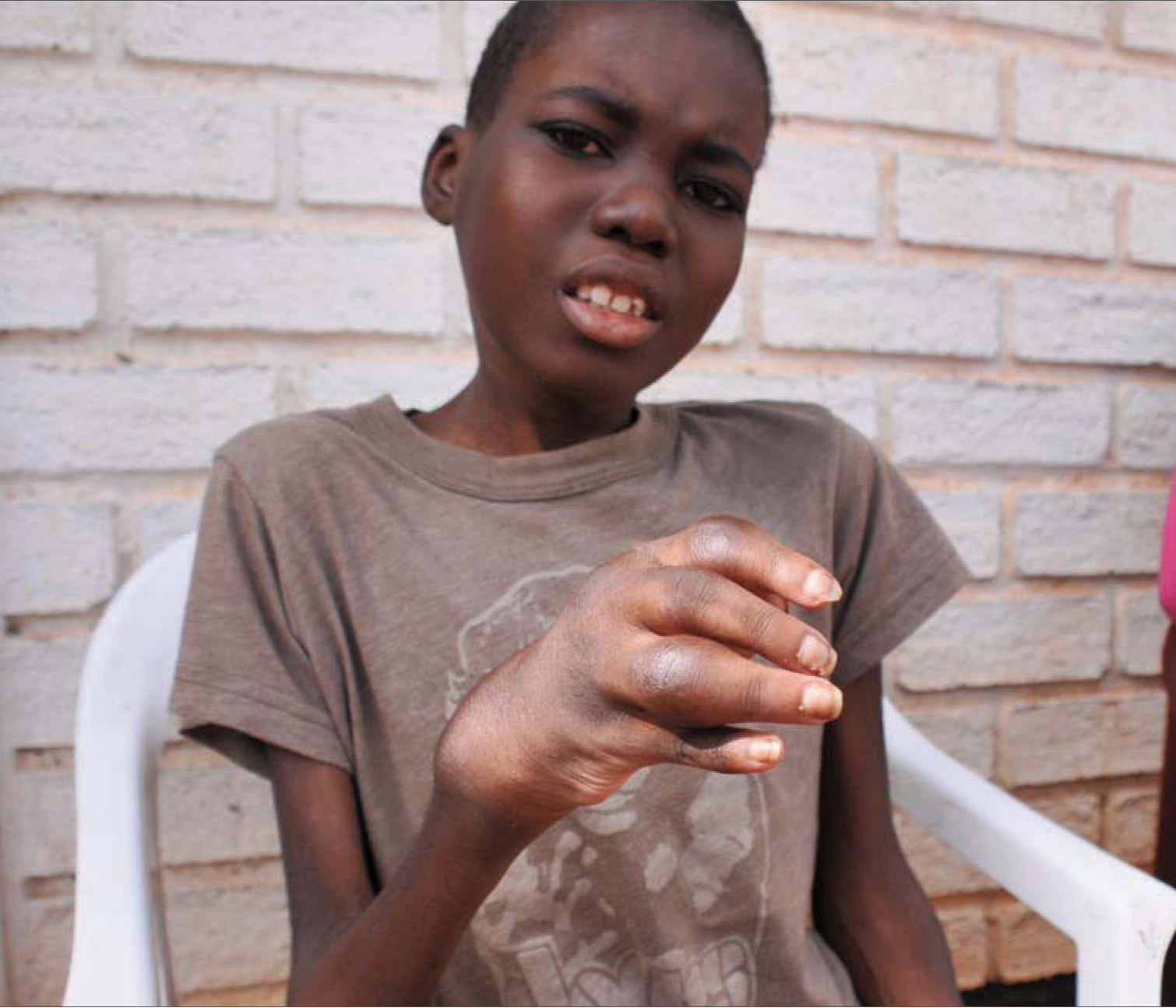
Brian, aged 12 and an orphan, was unable to hold a cup or dress himself due to multiple bleeds. He lives in Zimbabwe, several hours from a haemophilia treatment centre
“Each child is important. If we lose a child, we will post a photo and a little story about them on our website so that every child is preserved forever. They’re not just nameless children; they are all individuals”
Partner countries also need to have some form of haemophilia infrastructure. “Through Save One Life we’re also trying to train the NGOs how to handle money responsibly; starting by showing them the required documentation. We also encourage them to get out into the field to visit their own members, which a lot of them – believe it or not – do not do. They stay at the haemophilia treatment centre, at the office or their home, and they wait for the families to come to them. I read a book many years ago about humanitarian work in Africa, which mentioned an organization called The Flying Doctors; the founders wrote that in Africa you cannot wait for patients to come to you; you have to go visit them or they will die. And that’s our philosophy. NGOs responsible for these patients need to get out into the field and see how they live in their own home to understand what their needs are. We once had some guys in India go out on a very treacherous road, where they were chased by an elephant in the jungle, the car got stuck in the mud – but they said at the end of the day what a wonderful experience it was to actually go out and see these impoverished families.”
Laurie says this approach is very different than “top down” approaches, which tend to focus on health institutions and organisations. “We go bottom up, directly to the patients. The local haemophilia chapters or organisations are simply a vehicle to get to the individual patients.” Indeed, the name Save One Life derives from the Talmud quotation “He who saves one life saves the world”. “Each child is important. If we lose a child, we will post a photo and a little story about them on our website so that every child is preserved forever. They’re not just nameless children; they are all individuals,” says Laurie.
Save One Life was not an easy programme to get off the ground but Laurie says with the right people now on board it is getting stronger, not least with the support of the corporate sector. “Patrick Schmidt, CEO and founder of FFF Enterprises, has been our prime sponsor and donor for many years. His generosity I believe has spurred other captains of industry like Wolfgang Marguerre, chair of Octapharma, now our biggest donor and sponsor, to action and to become personally involved and concerned.”
Project SHARE – everything is tracked and traced
Project SHARE collects unused and unwanted blood clotting product from HTCs, patients’ families, pharmaceutical companies and homecare companies. “Whatever is not going to be used because someone either changed product or it’s close to expiration and they’re not going to use it, they send it to us.” says Zoraida Rosado, Project SHARE’s Program Director.
Supplies are gathered courtesy of the huge database that Laurie has amassed over the years. “My database of US families is about 3,500; it’s just enormous. So if you add in another 1,000 for the specialty pharmacies and 800 HTCs staff, it’s a huge network to draw on to ask for emergency supplies.”
Zoraida maintains a system through which donated product can then be delivered to wherever its needed within 24 hours. Requests for product are made online by doctors or societies on behalf of specific patients in around 50 countries at any given time, perhaps for treating a bleed or covering a surgery. All requests are reviewed by Zoraida, who will make contact and check on the status of the patient, some basic clinical data, how much factor is required, and so on. If a shipment is approved, there is a process of checks with the shipping company to ensure that the product clears customs and is delivered, and both doctor and patient sign the treatment log that accompanies the product, stating how much is used. This is then sent back to Zoraida. “I follow it all the way through. To this day, very little product has been lost: I can account for everything that has ever been sent out.”
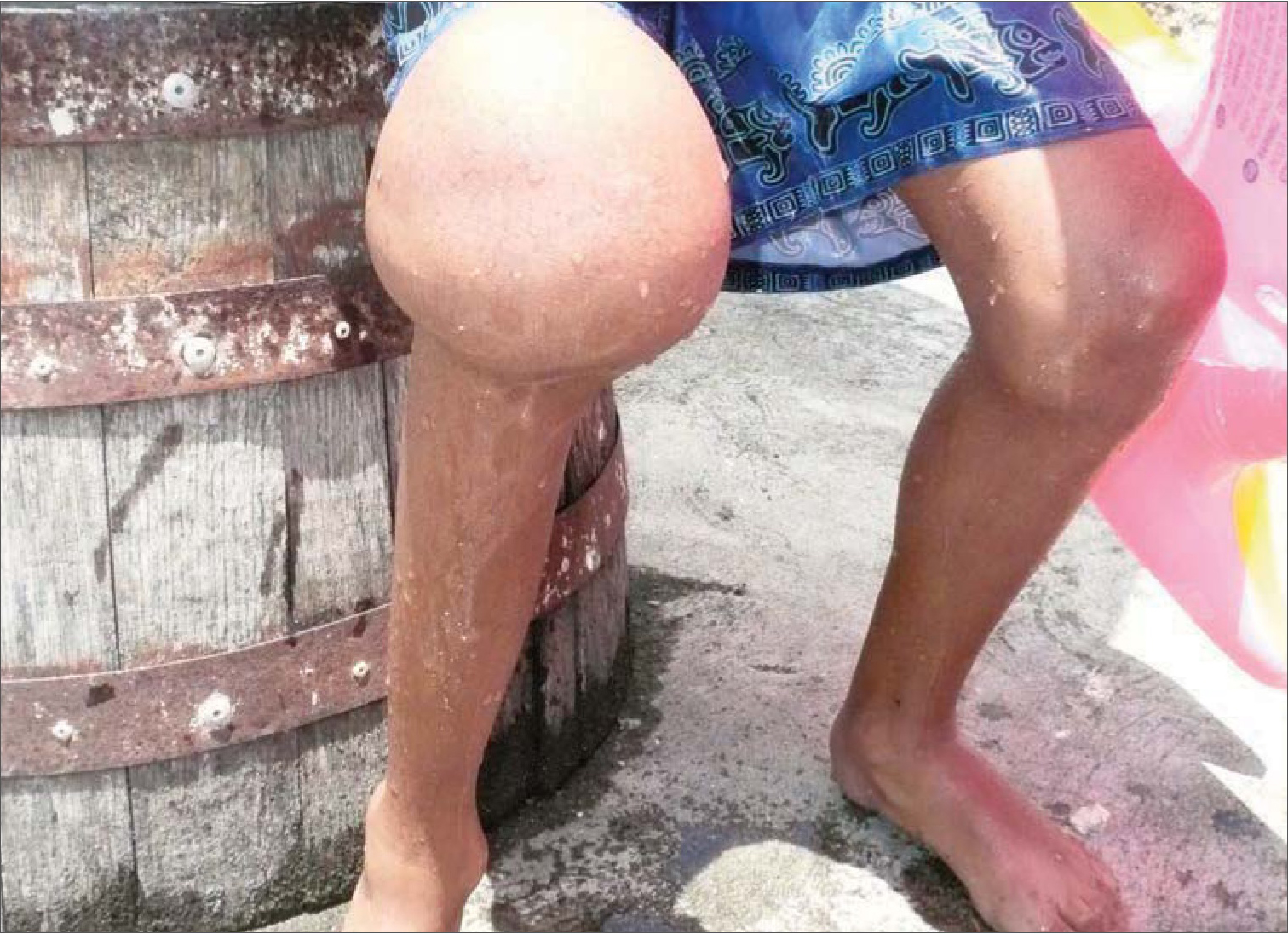
The devastating effects of untreated haemophilia: worldwide, 75% of people with haemophilia have little or no access to clotting factor
Project SHARE is not just in the business of charity: “We’re here to teach them how to manage factor shipments, complete documents and follow through”
Zoraida tells a story of one country where she sent factor at the request of a doctor for an apparent emergency. “The factor got to the hospital, but the doctor contacted me and said, ‘The patient’s not here anymore; can I give this to someone else?’ Zoraida asked for proof and insisted on a new request form before releasing the product to a new patient. She finds this strict approach the only way to manage requests and ensure that product gets through to those who need it.
The World Federation of Hemophilia operates a huge factor donation programme of its own, and Project SHARE keeps them posted on everything it does. “Every month since 2002 we have shared with the WFH all of our factor donations: what comes in, what goes out and where it goes,” says Laurie. “We have a very healthy and respectful relationship.” Perhaps the main difference between the two programmes is in the speed at which Project SHARE can move product to where it is needed, which means it can take very short dated factor. But it will not accept expired product, which is why it operates a waiting list. “We treat emergencies first – on demand requests come last. But I ensure that every single person on that waiting list gets factor, even if they have to wait 6 months.” (As we spoke, at the WFH congress in Melbourne, Zoraida was on her phone tracking an order through customs to reach an emergency case in Mexico.)
Zoraida stresses that they track every box, every product number and expiration date in case anything is recalled. “Every product that comes in gets registered, gets a code and it’s also registered when it goes out. In and out, everything is traced.”
Laurie adds that they once had a surprise inspection by the US FDA. “I looked up from my desk and there was an officer. He said, ‘We heard you’re shipping drugs.’ I joked, ‘We’re not drug smugglers. Come and sit down.’ He went through all the paperwork and said everything was fine, ‘but get a new refrigerator,’ which we did. I invited him back the next year, but he said, ‘Nobody invites the FDA for an inspection!’”
Of course, corruption is a constant challenge when working with some countries. While there are few countries that Project SHARE will not help, it picks its programme partners carefully. “I can’t easily get product into Egypt and Mexico. It will get lost or stolen. I send all the documents to customs, tell them who I am, that this is an emergency. It can take days to convince them to release it.”
Laurie adds, “It’s true there is corruption in some countries. But our problem is not so much corruption but programme partners who do not fill out the reports and return usage logs. If partners are noncompliant we have to eventually cut them loose. We’ve put two countries on probation, which means they have 6 months to get their act together, after which factor support will stop.”
Zoraida stresses that Project SHARE is not just in the business of charity: “We’re here to teach them how to manage factor shipments, complete documents and follow through.”
Factor donations can be used to motivate program partners to action. Project SHARE last year stopped supplying product to the Philippines until the haemophilia associations developed an advocacy strategy to appeal to their government for aid. “We’ll help countries as much as we can but we need to see them step up to the plate and work for themselves.”
Laurie believes that operations like Save One Life and Project SHARE will be needed for the foreseeable future. “Even if there were a cure for haemophilia, we don’t know what the price tag would be for it. Even in developed countries people always need extra money and need to know that they’re part of a bigger community, so I think there will always be room for both programmes.

For more information on donating factor via Project SHARE, please visit www.kelleycom.com/projectshare/
“There are so many countries that we haven’t yet touched. I just went to Rwanda and was only the second person from this community to go. It has a great public healthcare system, but it needs help, a little hand-holding to get going. And there are a lot of countries like that.”
Laurie adds: “My favourite quote is by Oscar Wilde, who said ‘Charity creates a multitude of sins’. If you just have pure charity, it’s not good; it breeds dependency and false expectations. Our programs help patients in need and who suffer, but also to teaches haemophilia communities to help themselves.”