Education and support during the shared decision-making process is key to ensuring that people with haemophilia are able to make informed therapeutic choices as gene therapy becomes more widely available as a treatment option
graphic/j_jhp-2023-0009_fig_001.jpg

Shared decision-making (SDM) is a process by which healthcare professionals (HCPs) and patients or their caregivers jointly reach a decision about care, described in haemophilia care by Athale et al. in 2014 as a two-sided intervention including tools to aid patient decision-making [1]. As such, it forms a core part of patient-centred care [2].

Approaches to SDM vary according to its context, including both generic models and models developed for specific healthcare settings [3,4]. However, in all contexts, it is based on a two-way exchange and synthesis of information between HCP and patient, recognising the combined value of the medical knowledge of the HCP and the experiential knowledge of the patient [3,5]. The exchange should encompass clinical evidence and individual patient/caregiver preferences, beliefs and values, and must include consideration of the risks, benefits and possible consequences of different treatment options [2]. The patient/caregiver must understand these and the range of therapeutic options available to them; the HCP must be equipped to provide information to the patient/ caregiver to support their understanding. While SDM is widely recommended in healthcare policy, the extent to which it is truly practised is unclear [6,7].

WHY IS SHARED DECISION-MAKING IMPORTANT IN HAEMOPHILIA CARE?

For many years, the choices for healthcare providers around haemophilia treatment options have been relatively simple: treatment on-demand to replace the missing coagulation factor when bleeds occur or, for people with severe haemophilia who bleed more frequently, initiating prophylaxis where sufficient factor concentrates are available [8]. The choice of treatment product, until recently, was limited to plasma-derived or recombinant products. Reducing the number of bleeds experienced was the greatest priority for people with haemophilia (PwH) [9], although the frequency of infusions under a prophylactic regimen led to greater treatment burden. Over time, the introduction of personalised prophylaxis, the modification of coagulation factor molecules to facilitate longer-acting treatments, and the development of non-factor replacement therapies have contributed to reducing this burden [10,11].

As contemporary haemophilia care has moved from factor replacement to novel therapies [12] and gene therapy [13], identifying the optimal haemophilia treatment for an individual is now a ‘difficult and multifaceted process’ [14]. It is therefore important that PwH and their families are involved in decisions around their care in an ‘informed and interactive way’. Ensuring that bleed protection continues is essential but must be considered alongside the hopes and expectations of PwH with regard to new treatments. Healthcare providers must also recognise that, as patients with a long-term condition, PwH have acquired expertise through their own lived experiences and may have differing opinions about treatment from those of their healthcare providers [15].

SHARED DECISION-MAKING AND GENE THERAPY FOR HAEMOPHILIA

Gene therapy is a new therapeutic option that may become part of routine clinical care for haemophilia. The nature of haemophilia gene therapy necessitates a commitment to a long-term treatment journey on the part of the patient, as once the vector is infused, it cannot be removed. It is a one-time only, irreversible treatment. In this context, SDM becomes both more complex and more necessary.

PwH need to be well informed about the process of gene therapy and must be enabled to engage in fully informed decision-making and consent [16]. Issues around long-term durability of factor expression and potential side effects (which are not fully known) must be understood by PwH. It is not possible to predict outcomes for haemophilia gene therapy, and a good initial response does not preclude loss of expression leading to reduced factor expression or failure of gene therapy [17]. Data on longer-term outcomes remain unknown at present due to the limited long term follow up of PwH in gene therapy trials. The known side effects of gene therapy currently include infusion related reactions, liver function abnormality or toxicity, and side effects of corticosteroids or other immunosuppression [17]. There is a theoretical risk of integration of the vector into the host genome which may predispose to malignancy [18]. Currently immune response to the vector, inducing vector antibody formation, means that re-dosing with the same vector is not possible[17]. Potential recipients of gene therapy must understand the risks and the need for long-term (potentially lifelong) follow-up within their decision-making process. It is, therefore, imperative that the understanding and expectations of PwH are central to all discussions about gene therapy as a treatment option, including ‘unknown unknowns’ about long-term impact [19].

HCPs and patient organisations both have a role in guiding and supporting PwH through their decisions around gene therapy as a treatment option [20], enabling them to be a full partner in the decision-making process [14,21]. This should include ensuring that they are empowered to choose not to have gene therapy at any time in their gene therapy journey prior to infusion [22]. There is an assumption that HCPs will be able to support non-biased shared decision making. Valentino et al. [23] recommend the provision of education and training around SDM for all those who ‘evaluate, administer and follow’ candidates who may receive haemophilia gene therapy. This is important in minimising potential therapeutic biases that could result in HCPs who do not perceive benefits of gene therapy swaying SDM and vice versa, and unconscious bias linked with the ethnicity, culture or educational level of individual PwH [2].

Patient preferences must be understood in order to ensure decision-making that supports the individual situations of PwH. Within this, it is important to understand the cognitive biases that the patient may also bring to the SDM process [24]. Attentional bias, for example, may lead to a selective focus on the benefits of gene therapy versus the risks or vice versa [22]. Social biases may include the influence of family members who have different treatment preferences; and as gene therapy is a new mode of treatment, familial and community links with the contaminated blood scandal may raise concerns [22,25]. Information or misinformation about gene therapy in the public domain is another potential social bias. Self-perception bias linked with an individual’s view of themselves as a person with haemophilia may also be a factor [22]. SDM provides a framework for discussing patient preferences and values in the context of available evidence [26].

HOW DO WE ENSURE SHARED DECISION-MAKING IS A REALITY?

For PwH to be fully involved in SDM in relation to gene therapy, they must have access to clear, relevant information and education. This should be based on tailored communication to ensure that those with ‘low levels of health literacy or socioeconomic disadvantage’ are not excluded [16,20].

Hermans et al. [14] describe patient involvement and education as two key principles in SDM. This includes a focus on ‘what really matters to patients and families in terms of treatment priorities, expectations and ambitions’, and the use of ‘jargon-free terminology’. All members of the healthcare team should be educated about new treatment options in order to be able to support PwH through the SDM process.

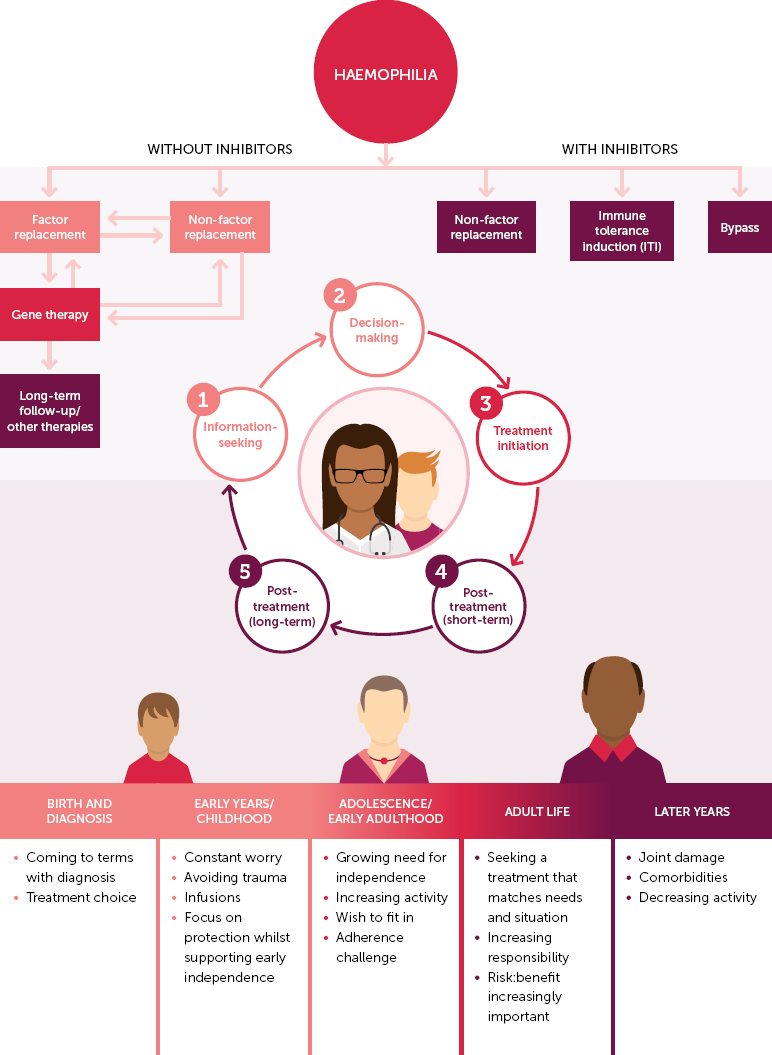
Supporting PwH in decision-making around gene therapy as a treatment option is a process (or journey) that may take a considerable amount of time from first discussion to dosing [21]. Wang et al. describe five pillars of the decision-making journey: ‘pre-gene therapy information seeking’, ‘pre-gene therapy decision-making’, ‘treatment initiation’, short-term post-gene therapy follow-up (≤ 1 year)’, long-term post-gene therapy follow-up (> 1 year)’ [19]. All of these elements must be considered when embarking on SDM discussions around haemophilia gene therapy and the process must not be rushed. Gene therapy is a complex treatment that, due to its nature, involves a complex and multifaceted decision-making journey that will be different for each individual (Figure 1). PwH will therefore require considerable education and support before they are able to make a truly informed decision.

Figure 1.

The patient decision-making journey in the current treatment landscape (cf. Wang et al., 2022) [19]
graphic/j_jhp-2023-0009_fig_002.jpg

The use of SDM structured tools to support patient decision-making is recommended as good practice [6]. The SHARE approach, designed by the US Agency for Healthcare Research and Quality, is commonly cited as an appropriate model in the context of haemophilia gene therapy [2,20,21]. This five-stage process is based on ‘Seeking patients’ participation, Helping patients explore and compare management options, Assessing patients’ values and preferences, Reaching a decision with patients, and Evaluating the patient’s decision’ [27]. While this model provides an important point of reference for the role and responsibilities of HCPs in SDM, it assumes that interaction is led by the HCP rather than the patient. However, the discussions that occur as part of the SDM process do not necessarily have to begin with HCPs. PwH may seek to initiate conversations around gene therapy, including SDM, and it is important that HCPs foster an environment in which this can happen. In either case, PwH must also be aware of their role in the SDM process, including education (supported by the HCP), careful consideration of benefits and risks, and open communication with the HCP around treatment goals and preferences [28].

There is a need for SDM educational tools that include written/visual information about the benefits and risks of gene therapy treatment, expectations and realities, and the need for long-term monitoring and follow-up [14,16,21]. Standardised checklists may be helpful for both PwH and HCPs, within and outside of the clinical setting. Having a point of reference of this kind can help to ensure that all elements that need to be discussed in clinic are discussed [18]. In the US, Limjoco and Thornburg have consulted people with haemophilia A and HCPs on the development of an SDM tool or tools for gene therapy, incorporating a checklist and taking both perspectives into account [29,30]. PwH felt that having access to an SDM tool laying out the pros and cons of gene therapy would support their decision-making outside of clinic through enabling further review and discussion with their families. The proposed checklist included education about gene therapy, risks, comparison with other treatments, follow up, impact on mental health and quality of life [29]. A tool aimed at facilitating HCP discussion has been developed, which can be used during patient discussions on gene therapy in combination with the SDM tool developed by the World Federation of Hemophilia (WFH) [27,30,31]. The WFH SDM tool is designed to assist with treatment selection and includes a significant number of downloadable patient education materials comparing currently available treatments alongside gene therapy [31]. It describes the SDM journey of reflecting on current personal goals and available treatments, considering future options and confirming a decision about treatment. As this tool will be widely accessible, it has the potential to support both HCP and PwH through the decisionmaking process. Going forward, the role and value of tools such as these should continue to be assessed from the perspectives of both PwH and healthcare providers [16,20].

For some PwH, SDM may be a new concept. They may have had little engagement in decision-making about their treatment previously and may perceive SDM as an intimidating prospect [2]. Patient organisations can play a valuable role in respect of both explaining new treatment paradigms such as gene therapy and supporting PwH in SDM [20]. This may include, for example, providing educational materials that support health literacy [16] and peer support groups to facilitate discussion about the process of gene therapy [21]. Support should be available for PwH for whom gene therapy proves not to be an accessible treatment option [32], and for PwH who would like to have gene therapy but whose choice is not supported by their healthcare provider or organisational policies.

CONCLUSION

SDM is an important aspect of haemophilia care and is a necessity as gene therapy becomes a more widely available treatment option. With haemophilia gene therapy, healthcare professionals are asking PwH to make decisions about a treatment that may not work as well as they had hoped, that can currently only be undertaken once, and for which we cannot offer long-term safety guarantees. It is therefore essential that they are equipped with the knowledge, skills and confidence to support SDM. Recent recommendations from the UK National Institute for Health and Care Excellence (NICE) for research around measuring the effectiveness and sustained implementation of SDM in the clinical setting [6] should be considered in the context of haemophilia treatment choices and SDM for haemophilia gene therapy.

Education and support of PwH during the SDM process using currently available and developing SDM tools [27,30,31] are paramount to ensure fully informed individual decision-making and consent. The development of tools to ensure equitable access to education and information about haemophilia gene therapy and the patient journey are now starting to be developed. Patient organisations are key in supporting their members to make appropriate decisions about gene therapy, as well as campaigning for access and funding as these treatments become clinically available. The most important part of this process is that PwH want to undergo gene therapy – and this is only an option if they are fully educated and informed by fully educated and informed healthcare teams.

ACKNOWLEDGEMENTS

Simon Fletcher, Kathryn Jenner and Khair Khair are employees of Haemnet Ltd. Kate Khair is a shareholder of Haemnet Ltd and Editor-in-Chief of The Journal of Haemophilia Practice. Kathryn Jenner is Technical Editor of The Journal of Haemophilia Practice.

This paper does not contain any studies involving human participants or animals performed by any of the authors.

REFERENCES

1. 

Athale A, Giguere A, Barbara A, Krassova S, Iorio A. Developing a two-sided intervention to facilitate shared decision-making in haemophilia: decision boxes for clinicians and patient decision aids for patients. Haemophilia. 2014 Nov;20(6):800-6.

A Athale A Giguere A Barbara S Krassova A Iorio .Developing a two-sided intervention to facilitate shared decision-making in haemophilia: decision boxes for clinicians and patient decision aids for patients.Haemophilia.2014Nov;20(6):800-6.

2. 

Valentino LA, Blanchette V, Negrier C, O’Mahoney B, Vias V, Sannie T, Skinner M. Personalising haemophilia management with shared decision making. J Haem Pract 2021; 8(1) 69-79. doi:10.17225/jhp/00178

LA Valentino V Blanchette C Negrier B O’Mahoney V Vias T Sannie M Skinner .Personalising haemophilia management with shared decision making.J Haem Pract2021;8(1)69-79. doi:10.17225/jhp/00178

3. 

Bomhof-Roordink H, Gärtner FR, Stiggelbout AM, Pieterse AR. Key components of shared decision making models: a systematic review. BMJ Open 2019; 9: e031763. doi: 10.1136/bmj.open-2019-031763.

H Bomhof-Roordink FR Gärtner AM Stiggelbout AR Pieterse .Key components of shared decision making models: a systematic review.BMJ Open2019;9:e031763. doi:10.1136/bmj.open-2019-031763.

4. 

Légaré F, Härter M, Stiggelbout AM, Thomson R, Stacey D. Choosing treatments and the role of shared decision-making. In: North J, Nolte E, Merkur S, Anell a (eds.), Achieving Person-Centred Health Systems: Evidence, Strategies and Challenges. 2020. Cambridge: Cambridge University Press. 283-316. doi: 10.1017/9781108855464.014.

F Légaré M Härter AM Stiggelbout R Thomson D Stacey .Choosing treatments and the role of shared decision-making. In: J North E Nolte S Merkur a Anell (eds.),Achieving Person-Centred Health Systems: Evidence, Strategies and Challenges.2020.Cambridge:Cambridge University Press.283-316. doi:10.1017/9781108855464.014.

5. 

Charles C, Gafni A, Whelan A. Decision-making in the physician-patient encounter: revisiting the shared treatment decision-making model. Soc Sci Med 1999; 49(5): 651-61. doi: 10.1016/s0277-9536(99)00145-8.

C Charles A Gafni A Whelan .Decision-making in the physician-patient encounter: revisiting the shared treatment decision-making model.Soc Sci Med1999;49(5):651-61. doi:10.1016/s0277-9536(99)00145-8.

6. 

National Institute for Health and Care Excellence. Shared decision making. NICE guideline [NG197]. Published 17 June 2021. Available from https://www.nice.org.uk/guidance/ng197 (accessed July 2023).

National Institute for Health and Care Excellence .Shared decision making.NICE guideline [NG197].Published 17 June 2021. Available from https://www.nice.org.uk/guidance/ng197(accessed July 2023).

7. 

Elwyn G, Durand MA, Song J, et al. A three-talk model for shared decision making: multistage consultation process. BMJ 2017; 359: j4891. doi: 10.1136/bmj.j4891.

G Elwyn MA Durand J Song .A three-talk model for shared decision making: multistage consultation process.BMJ2017;359:j4891. doi:10.1136/bmj.j4891.

8. 

Srivastava A, Santagostino E, Dougall A, et al.; WFH Guidelines for the Management of Hemophilia panelists and co-authors. WFH Guidelines for the Management of Hemophilia, 3rd edition. Haemophilia 2020; 26 Suppl 6:1-158. doi: 10.1111/hae.14046.

A Srivastava E Santagostino A Dougall .;WFH Guidelines for the Management of Hemophilia panelists and co-authors. WFH Guidelines for the Management of Hemophilia,3rd edition.Haemophilia2020;26Suppl 6:1-158. doi:10.1111/hae.14046.

9. 

Mühlbacher AC, Sadler A, Lamprecht B, Juhnke C. Patient preferences in the treatment of hemophilia A: A Best-Worst Scaling Case 3 analysis. Value Health 2020 Jul;23(7):862-869. doi: 10.1016/j.jval.2020.02.013.

AC Mühlbacher A Sadler B Lamprecht C Juhnke .Patient preferences in the treatment of hemophilia A: A Best-Worst Scaling Case 3 analysis.Value Health2020Jul;23(7):862-869. doi:10.1016/j.jval.2020.02.013.

10. 

Coppola A, Franchini M, Pappagallo G, et al. Current choices and management of treatment in persons with severe hemophilia A without inhibitors: a mini-Delphi consensus. J Clin Med 2022; 11(3): 801. doi: 10.3390/jcm11030801.

A Coppola M Franchini G Pappagallo .Current choices and management of treatment in persons with severe hemophilia A without inhibitors: a mini-Delphi consensus.J Clin Med2022;11(3):801. doi:10.3390/jcm11030801.

11. 

Fletcher S, Jenner K, Holland M, Khair K. The lived experience of a novel disruptive therapy in a group of men and boys with haemophilia A with inhibitors: Emi & Me. Health Expect 2022; 25(1): 443-454. doi: 10.1111/hex.13404.

S Fletcher K Jenner M Holland K Khair .The lived experience of a novel disruptive therapy in a group of men and boys with haemophilia A with inhibitors: Emi & Me.Health Expect2022;25(1):443-454. doi:10.1111/hex.13404.

12. 

Gualtierotti R, Pasca S, Ciavarella A, et al. Updates on novel non-replacement drugs for hemophilia. Pharmaceuticals (Basel) 2022; 15(10): 1183. doi: 10.3390/ph15101183..

R Gualtierotti S Pasca A Ciavarella .Updates on novel non-replacement drugs for hemophilia.Pharmaceuticals (Basel)2022;15(10):1183. doi:10.3390/ph15101183..

13. 

Gogia P, Tarantino M, Schramm W, Aledort L. New directions to develop therapies for people with hemophilia. Expert Rev Hematol 2023 Mar 8:1-17. doi: 10.1080/17474086.2023.2184341. Epub ahead of print.

P Gogia M Tarantino W Schramm L Aledort .New directions to develop therapies for people with hemophilia.Expert Rev Hematol2023Mar8:1-17. doi:10.1080/17474086.2023.2184341. Epub ahead of print.

14. 

Hermans C, Noone D, Benson G, et al. Hemophilia treatment in 2021: Choosing the “optimal” treatment using an integrative, patient-oriented approach to shared decision-making between patients and clinicians. Blood Rev 2022; 52: 100890. doi: 10.1016/j.blre.2021.100890.

C Hermans D Noone G Benson .Hemophilia treatment in 2021: Choosing the “optimal” treatment using an integrative, patient-oriented approach to shared decision-making between patients and clinicians.Blood Rev2022;52:100890. doi:10.1016/j.blre.2021.100890.

15. 

Scalone L, Mantovani LG, Borghetti F, Von Mackensen S, Gringeri A. Patients’, physicians’, and pharmacists’ preferences towards coagulation factor concentrates to treat haemophilia with inhibitors: results from the COHIBA Study. Haemophilia 2009; 15(2): 473-86. doi: 10.1111/j.1365-2516.2008.01926.x.

L Scalone LG Mantovani F Borghetti S Von Mackensen A Gringeri .Patients’, physicians’, and pharmacists’ preferences towards coagulation factor concentrates to treat haemophilia with inhibitors: results from the COHIBA Study.Haemophilia2009;15(2):473-86. doi:10.1111/j.1365-2516.2008.01926.x.

16. 

Woollard L, Gorman R, Rosenfelt DJ. Addressing patient education priorities in the era of gene therapy for haemophilia: Towards evidence-informed shared decision-making. Haemophilia 2021; 27(2): e302-e304. doi: 10.1111/hae.14214.

L Woollard R Gorman DJ Rosenfelt .Addressing patient education priorities in the era of gene therapy for haemophilia: Towards evidence-informed shared decision-making.Haemophilia2021;27(2):e302-e304. doi:10.1111/hae.14214.

17. 

Leebeek FWG, Miesbach W. Gene therapy for hemophilia: a review on clinical benefit, limitations, and remaining issues. Blood. 2021 Sep 16;138(11):923-931

FWG Leebeek W Miesbach .Gene therapy for hemophilia: a review on clinical benefit, limitations, and remaining issues.Blood.2021Sep16;138(11):923-931

18. 

Miesbach W, Foster GR, Peyvandi F. Liver-related aspects of gene therapy for haemophilia: Call to action for collaboration between haematologists and hepatologists. J Hepatol 2023; 78(3): 467-470. doi: 10.1016/jhep.2022.11.014.

W Miesbach GR Foster F Peyvandi .Liver-related aspects of gene therapy for haemophilia: Call to action for collaboration between haematologists and hepatologists.J Hepatol2023;78(3):467-470. doi:10.1016/jhep.2022.11.014.

19. 

Wang M, Negrier C, Driessler F, Goodman C, Skinner MW. The hemophilia gene therapy patient journey: questions and answers for shared decision-making. Patient Prefer Adherence 2022; 16: 1439-1447. doi: 10.2147/PPA.S355627.

M Wang C Negrier F Driessler C Goodman MW Skinner .The hemophilia gene therapy patient journey: questions and answers for shared decision-making.Patient Prefer Adherence2022;16:1439-1447. doi:10.2147/PPA.S355627.

20. 

Limjoco J, Calatroni A, Aristizabal P, Thornburg CD. Gene therapy preferences and informed decision-making: Results from a National Hemophilia Foundation Community Voices in Research survey. Haemophilia 2023; 29 (1): 51-60. doi: 10.1111/hae.14706.

J Limjoco A Calatroni P Aristizabal CD Thornburg .Gene therapy preferences and informed decision-making: Results from a National Hemophilia Foundation Community Voices in Research survey.Haemophilia2023;29(1):51-60. doi:10.1111/hae.14706.

21. 

Noone D, Astermark J, O’Mahoney B, et al. The journey of gene therapy in haemophilia – putting the patient at the centre of the hub and spoke model. J Haem Pract 2022; 9(1): 156-166. doi10.2478/jhp-2002-0021.

D Noone J Astermark B O’Mahoney .The journey of gene therapy in haemophilia – putting the patient at the centre of the hub and spoke model.J Haem Pract2022;9(1):156-166. doi10.2478/jhp-2002-0021.

22. 

Fletcher S, Jenner K, Holland M, Chaplin S, Khair K. An exploration of why men with severe haemophilia might not want gene therapy: The Exigency study. Haemophilia 2021; 27(5): 760-768. doi: 10.1111/hae.14378.

S Fletcher K Jenner M Holland S Chaplin K Khair .An exploration of why men with severe haemophilia might not want gene therapy: The Exigency study.Haemophilia2021;27(5):760-768. doi:10.1111/hae.14378.

23. 

Valentino LA, Kaczmarek R, Pierce GF, Noone D, O’Mahoney B, Page D, Rotellini D, Skinner MW. Hemophilia gene therapy: First do no harm. J Thromb Haemost 2023 June 21. doi: 10.1016/j.tha.2023.06.016. [Epub ahead of print].

LA Valentino R Kaczmarek GF Pierce D Noone B O’Mahoney D Page D Rotellini MW Skinner .Hemophilia gene therapy: First do no harm.J Thromb Haemost2023June21. doi:10.1016/j.tha.2023.06.016. [Epub ahead of print].

24. 

Savioni L, Triberti S. Cognitive biases in chronic illness and their impact on patients’ commitment. Front Psychol 2020; 11: 579455. doi: 10.3389/fpsyg.2020.579455.

L Savioni S Triberti .Cognitive biases in chronic illness and their impact on patients’ commitment.Front Psychol2020;11:579455. doi:10.3389/fpsyg.2020.579455.

25. 

Khair K, Steadman L, Chaplin S, et al. Parental perspectives on gene therapy for children with haemophilia: The Exigency study. Haemophilia 2020; 27(1): 120-128. doi: 10.1111.

K Khair L Steadman S Chaplin .Parental perspectives on gene therapy for children with haemophilia: The Exigency study.Haemophilia2020;27(1):120-128. doi:10.1111.

26. 

Politi MC, Dizon DS, Frosch DL, Kuzemchak MD, Stiggelbout AM. Importance of clarifying patients’ desired role in shared decision making to match their level of engagement with their preferences. BMJ 2013; 347: f7066. doi: 10.1136/bmj.f7066.

MC Politi DS Dizon DL Frosch MD Kuzemchak AM Stiggelbout .Importance of clarifying patients’ desired role in shared decision making to match their level of engagement with their preferences.BMJ2013;347:f7066. doi:10.1136/bmj.f7066.

27. 

The SHARE Approach. Agency for Healthcare Research and Quality, Rockville, MD. https://www.ahrq.gov/health-literacy/professional-training/shared-decision/index.html (last accessed March 2023).

The SHARE Approach .Agency for Healthcare Research and Quality,Rockville, MD. https://www.ahrq.gov/health-literacy/professional-training/shared-decision/index.html(last accessed March 2023).

28. 

Nossair F, Thornburg CD. The role of patient and healthcare professionals in the era of new haemophilia treatments in developed and developing countries. Ther Adv Hematol 2018; 9(8): 239-249. doi: 10.1177/2040620718784830.

F Nossair CD Thornburg .The role of patient and healthcare professionals in the era of new haemophilia treatments in developed and developing countries.Ther Adv Hematol2018;9(8):239-249. doi:10.1177/2040620718784830.

29. 

Limjoco J, Thornburg CD. Gene therapy for hemophilia A: A mixed methods study of patient preferences and shared decision-making. Patient Prefer Adherence 2023 Apr 19;17:1093-1105. doi: 10.2147/PPA.S406894.

J Limjoco CD Thornburg .Gene therapy for hemophilia A: A mixed methods study of patient preferences and shared decision-making.Patient Prefer Adherence2023Apr19;17:1093-1105. doi:10.2147/PPA.S406894.

30. 

Limjoco J, Thornburg CD. Development of a haemophilia A gene therapy shared decision-making tool for clinicians. Haemophilia 2023 July 4. doi: 10.1111/hae.14822. Epub ahead of print.

J Limjoco CD Thornburg .Development of a haemophilia A gene therapy shared decision-making tool for clinicians.Haemophilia2023July4. doi:10.1111/hae.14822. Epub ahead of print.

31. 

Noone D, Chadwick J, Coffin D, Hayes B, Kaeser G, Naccache M, Skinner M, Sannie T, Thornburg C, Pierce G. A new tool to assist in treatment selection – the World Federation of Hemophilia (WFH) shared decision making (SDM) tool. Presented at ISTH 2023 (in press).

D Noone J Chadwick D Coffin B Hayes G Kaeser M Naccache M Skinner T Sannie C Thornburg G Pierce .A new tool to assist in treatment selection – the World Federation of Hemophilia (WFH) shared decision making (SDM) tool.Presented at ISTH 2023(in press).

32. 

Fletcher S, Jenner K, Holland M, Khair K. Expectation and loss when gene therapy for haemophilia is not an option: An Exigency sub-study. Haemophilia 2023; 29(3): 776-783. doi: 10.1111/hae.14774.

S Fletcher K Jenner M Holland K Khair .Expectation and loss when gene therapy for haemophilia is not an option: An Exigency sub-study.Haemophilia2023;29(3):776-783. doi:10.1111/hae.14774.