In any given population, around 1 in 10,000 people will be born with haemophilia. In the UK, access to the National Health Service and in particular to specialist services means that for those born with haemophilia and other inherited bleeding disorders there is funding available to provide professionals dedicated to delivering up to date care and treatment. This enables those living with bleeding disorders to lead a full and almost normal life.
Bangladesh has a population in excess of 150 million, resulting in an estimated haemophilia population of 14,000. However, given the lack of funding, supplies and the necessary professionals and knowledge, few have been diagnosed. Even fewer have access to specialist care or treatment for bleeds.
For those who are diagnosed and whose family can afford treatment, whole blood or fresh frozen plasma are the most likely treatments available for bleeds. For most, haemophilia is a life sentence. Many do not survive childhood while those who make it into adolescence and adulthood do so with much pain and disability.
This situation is reflected in many other developing countries. It is for this reason the World Federation of Hemophilia developed its Twinning Programme, now in its 16th year, under which haemophilia centres in emerging countries are twinned with centres in established countries. This two-way partnership imparts knowledge and support to enable the developing centre to deliver safe and appropriate care.
The twinning relationship is a formal partnership lasting four years, with annual goal setting, but often continues long after the official completion.
The Royal London Hospital (RLH) is a tertiary hospital within the North London Haemophilia Network, which also provides a local hospital to the population of the London Borough of Tower Hamlets.
“We hoped that by demonstrating the teamwork between doctor and nurses, we might help to break down the traditional hierarchy that remains evident in working relationships in Dhaka”
Despite being situated a few miles east of the financial centre of London, Tower Hamlets is a relatively deprived borough. The local population is ethnically diverse, with Bangladeshis being the largest ethnic minority. Once the decision was made in 2010 to participate in the twinning program, Bangladesh was an obvious choice as a twin. The RLH was formally twinned with two hospitals, Bangabandhu Sheikh Mujib Medical University (BSMMU) and Dhaka Medical College and Hospital (DMCH) in Dhaka, Bangladesh.
Since the beginning of the twinning programme, the patient group in Bangladesh has established a network of hospitals. It is hoped that the partnership will provide good haemophilia care not only for those living in and around Dhaka, but also for those families travelling back and forth between London and Dhaka.
Pre-twinning care in Dhaka
Prior to the Twinning Programme, haemophilia care in Dhaka was minimal. The haematology departments struggled to cope with general haematology and haematological malignancies, leaving little if any room for haemophilia.
In the early 1990s a motivated group of parents and patients developed the Dhaka Haemophilia Society, which introduced an informal centre (essentially the ground floor of the director’s house) that provided advice, and where possible small amounts of treatment, using occasional donations of factor concentrates from the WFH. In the absence of factor treatment, bleeds were treated with whole blood or fresh frozen plasma purchased by patients from the local transfusion service. This was either self-infused or infused with help from the Haemophilia Society. With little demand, cryoprecipitate was not manufactured in Dhaka.
Since 2010, the teams in Dhaka have established a haemophilia network of three large hospitals (BSMMU, DMCH and Shishu Children’s Hospital) with additional outreach to Chittagong Medical College. At both BSMMU and DMCH, there is a dedicated space for a multidisciplinary team clinic with a dedicated physiotherapist who often provided her time for a much-reduced fee (sometimes for no charge). The team participated in a joint scoring project presented at WFH 2012 [1].
There has also been an improvement in diagnostic techniques. Following a twinning laboratory training workshop in spring 2012, the laboratories are now performing reproducibly accurate clotting screens, as well as factor VIII and IX levels, thus ensuring the right diagnosis. Cryoprecipitate is now available for those with haemophilia A; it is clearly important that treatment is prescribed to those with a correct diagnosis. The lab is now participating in the WFH external quality assurance scheme.
The onward march of the nurse
The next part of the twinning process was to address front-line clinical care of haemophilia, which in the UK usually falls to nurses. In 2012, after much lobbying, the Bangladesh Government approved the appointment of 10 permanent haematology (haemophilia & bone marrow transplant) specialist nurses for DMCH and BSMMU. This was a big step for both haemophilia and for nurses working for government funded hospitals: previously their contracts included an obligatory rotation of practice area every 3 years.
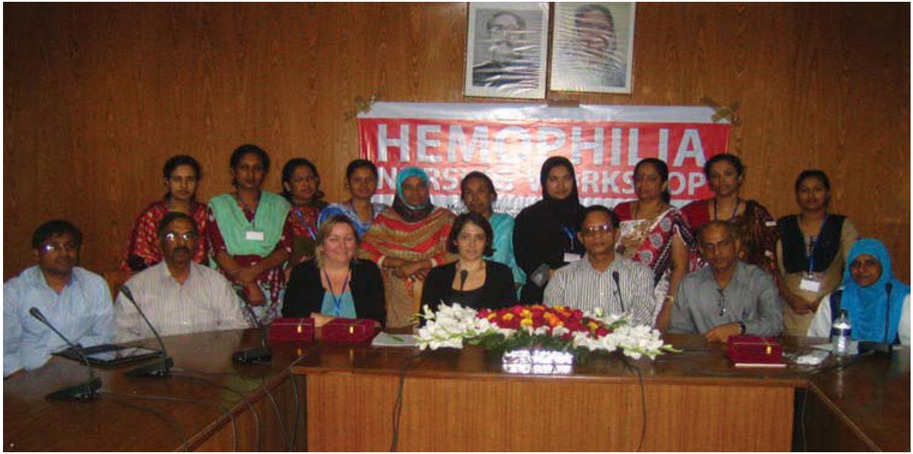
It was decided that the next team to visit Dhaka would run a nursing workshop designed to teach the newly appointed haemophilia nurses the basics of haemophilia. The team established to run the nursing workshop in February 2013 were Dr Dan Hart, haemophilia consultant at RLH, Kate Forsyth, haemophilia nurse specialist at RLH and Dr Kate Khair, nurse consultant at Great Ormond Street Hospital.
By pooling experience from the North London Network, we brought to Dhaka a wealth of nursing experience. We hoped that by demonstrating the teamwork between doctor and nurses, we might help to break down the traditional doctor-nurse hierarchy that remains evident in many of the texts describing working relationships in Dhaka.
In Bangladesh, nursing is not a profession that many aspire to; those who become nurses have been described as “widows and destitute women who are searching for an income” in doing so they are forced into a “dirty job” with a poor social appreciation [2]. The average monthly salary is around 10,000 taka, which is less than £100. Even after allowing for the low living costs, it is not a well paid job.
By contrast, nursing in the UK and other developed countries is often seen as an admirable vocation. Ehrenreich and English [3] wrote that the Nightingale nurse was the “ideal lady, with selfless, motherly devotion to the patient” who brought “absolute obedience to the doctor.” Clearly, times have changed and nurses are no longer the doctor’s handmaiden. Nursing has moved on further with the evolution of specialist and consultant nurse roles. The necessary development of significant skill and specialist knowledge for these positions has led to a greater expectation and desire for independence that is now reflected in many haemophilia nurses in UK hospitals.
The haemophilia nursing workshop
After the introduction of the nursing degree (BSc) courses in Dhaka in 2011, nurses who held a diploma appear to be regarded as under qualified, unskilled with a poor knowledge base. Doctors are pinning their hopes on the increased numbers of degree nurses to improve the standards and the abilities of nurses. It became clear that the 10 new Dhaka haematology nurses waiting for their haemophilia workshop shared more of the aspirations and potential of new UK nurses than the more deferential and “poorly educated” Bangladeshi nurse stereotype we had been expecting.
Our workshop was initially planned to provide basic training about haemophilia based on the guidance of the senior Dhaka doctors. However, on meeting the nurses, it was apparent that their knowledge base was significantly greater than expected: their nurse training was of diploma level, which followed the UK nursing syllabus.
All 10 nurses were women, as nursing remains an almost universal female vocation in Bangladesh. With mixed religious backgrounds (Muslims, Hindus and Christians), only one of the ten was unmarried, eight of the married nurses had one or two children each, along with maids to look after them so that they could concentrate on their careers. The introduction of immunisation led to reduced infant mortality, and a growing confidence in having smaller families. This too contradicted much of our preparatory reading.
In order to establish what our nurses knew, we set them a quiz asking general questions about haemophilia and its treatment. It was important to establish a baseline from which to start teaching. They all did well, which was surprising as we’d been led to believe that their baseline knowledge was poor!
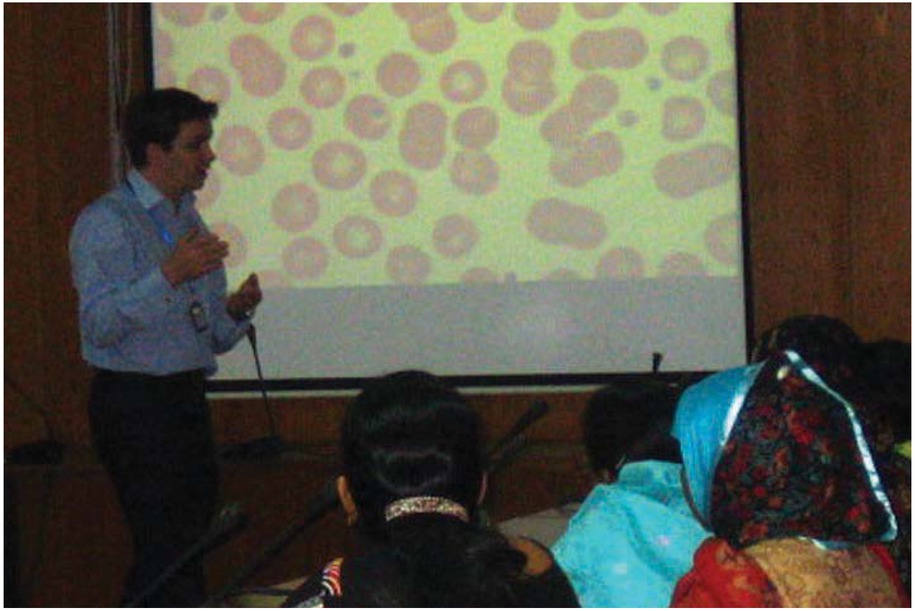
The plans for the workshop clearly needed to be revised. Presentations on how blood clots, bleeding disorders and treatment of bleeding were then delivered. The nurses were then divided into three groups, with each being asked what they felt the challenges and concerns were for people with haemophilia in three different age groups (0 to 5 years, 5-18 years, 18 years and over). It was clear that group work and being asked to think about how their patients’ lives could be affected by their bleeding disorder was an entirely new way of learning for them (Table 1).
Table 1
Nurses’ concerns for patients with haemophilia
The concepts of nursing competencies (soon to be made available in The Journal of Haemophilia Practice) were discussed. The potential for career development and the recording of it were new concepts about which all seemed excited. Next we discussed the multidisciplinary team, brainstorming every person involved in the care of a person with haemophilia, and focusing on the central and coordinating role of the haemophilia nurse. This proved an enlightening and particularly empowering session for all 10 nurses.
On the second day, the Bangladesh Haemophilia Society had arranged for a number of families with haemophilia to attend an interactive session. After spending the morning getting to know the visiting patients and families, the nurses were again split into three groups, and given five questions aimed at generating a conversation in which to get to know the patient. Three families were invited to sit and talk to the nurses. The nurses found this task difficult, with some asking the questions and no more.
“We discussed the multidisciplinary team, focusing on the central and coordinating role of the haemophilia nurse. This proved an enlightening and empowering session for all 10 nurses”
For all three families, the cost of treating and caring for a family member with haemophilia was a great concern, as was the anxiety surrounding the possibility of having more than one child with haemophilia. At 1200 taka (almost £10) for an APTT test, most families lacked sufficient funds to have their children tested and therefore had no way of knowing which boys would be affected until they started to bleed.
The lack of haemophilia facilities posed a difficulty for most families: one family had to travel over 120 km for care, but even then there is no guarantee of treatment. For others anxiety and depression are common as they are unable to fit in to the social norms, resulting in restriction of family size, feeling unable to care or finance further children who might be born with haemophilia. Their concerns also cover worries about their child not fitting into society, or being unable to work as they get older.
All three families had bad experiences with their first bleeding episode: each story involved days spent seeking medical care, or bleeding from an injury for several days. All three agreed, as might be expected, that their principal wish was for more readily available care, in a specific haemophilia centre with affordable treatment, access to comprehensive care including dentistry, physiotherapy and counselling. Lastly they wished for national exposure of haemophilia, and information for all to access, to counter the stigma faced by those living with haemophilia.
In our final group work session with the visiting families, we discussed inheritance. In their groups the nurses set to establish and draw the patients’ family tree. We looked back to establish obligate carriers, potential carriers and those affected, highlighting the importance of identifying women “at risk”, either of bleeding complications themselves, or of having a child with haemophilia.
Of the visiting families some were unable to identify their bleeding history and consequently were not able to relate their current bleeding experiences with previous ones. Had there been some genetic understanding and counselling some of their worries may have been properly explained and enabling them to make solid decisions in areas such as family planning.
The nurses had a good understanding of English, which allowed an open style of teaching with easy dialogue. The workshop was intended to be a nurse led workshop for nurses, therefore, we had requested that no doctors be present, in particular for the group work. This was intended to ensure that the group dynamics remained as relaxed as possible without any inhibition that might arise by the presence of consultant colleagues. Nevertheless, periodically the doctors crept in; some were present in the family sessions for interpreting purposes only. It was noted, however, there were occasions when the doctors felt it necessary to assert their authority towards both nurses and patients alike, supporting opinions of hierarchy.
The final teaching session of the workshop was on genetics and inheritance. It was a collaborative teaching session taught by nurses and doctors. This enabled the Dhaka teams to see how with a break down of hierarchy, clinical teams can work well together, with each playing a significant role. This involved teaching both doctor and nurse alike and it was interesting to see the Dhaka host professor sitting with his nurses learning from UK nurses and doctor.
Personal reflections on the experience
From a personal angle, the idea of leaving the safety of a well established, well-equipped haemophilia centre, going to an area where the need is likely to be great, overwhelming even, with less than adequate facilities and expertise, was daunting. Added to this the anticipated reception was also quite a frightening prospect. Had we come all this way to bring some hope to an area of need, only to be dismissed because of people’s social expectations and preconceived ideas? I hoped not. The published literature did not support us and yet the workshop was a success. Were we able to impart enough for these new leaders in a developing but deprived community to continue to develop, both for haemophilia and also for nursing, into the specialist nurses that we have become in the UK?
Rafia Khatun from Dhaka Medical College Hospital gives her impression of the training provided through the WFH twinning programme
Before taking part in training on haemophilia in February 2013, I was confused about this disease. Now I know many things about haemophilia.
A few days back, I got a patient at the haemophilia clinic who came from a poor family. At first, I took his history, which was similar to haemophilia. After suspecting this patient’s sign and symptoms as haemophilia, I gave him some advice to modify his lifestyle and use the emergency precaution. When I told the family about this, they became worried. I explained this disease to them clearly. Then, I sent them to the haematology department. The doctor gave some medical tests for diagnosis of haemophilia. After getting the medical report the doctor confirmed that it was haemophilia and that my suspicion was correct. My confidence developed after taking the training.
Then we admitted the patient in our ward. I served the patient appropriately. The patient is becoming well day by day. You will be happy to know about our Dhaka Medical College Hospital, Dhaka. We make an outdoor clinic for the patients of haemophilia. One day in a week, or four or five days in every month, we see patients with haemophilia and give them proper nursing care and advice.

Now most of them are well and out of danger. This is why I’m very happy to serve them. I have talked with nurses who attended that training course. They informed me that they have also noticed some changes among themselves and now they are able to provide nursing care to the haemophilia patients. All this became possible for the training we got from you. We all are grateful to you.
This was certainly an experience to remember. We were received gratefully: a big fuss and much work had gone to making this workshop and twinning experience a success. I returned to London, with a different outlook; we may feel the NHS is not what it once was but we too often forget just how well we care for and provide for our patients. We also forget just how far haemophilia nursing in the UK has come: once at the beck and call of a doctor, not as senior as a registrar or consultant. Now we are training them.
“We also forget just how far nursing in the UK has come: once at the beck and call of a doctor, now we are training them. The doctor’s handmaidens we are not.”
The doctor’s handmaidens we are not.
But there is much also for us to learn from the developing world. Such experiences lead us to think about how we treat our patients and whether we, at times, should treat more conservatively. Is there a balance needed in order to provide good care and quality of life while at the same time not overly exposing patients to factor concentrates and the potential for inhibitor development?
Programmes such as these are a fantastic way to develop centres, both in the developing world and the developed.
There is always much to learn and ways to refocus our approach to practice. Working collaboratively with neighbouring institutions can also build up experience for all involved by expanding our knowledge and way of practice. It is a big undertaking but with a supportive team, this is a challenge that can be taken on by any experienced or motivated member of a haemophilia MDT.