Clinical Research | Open Access | Volume 13 (2026): Issue 1 | Pages 14–23 | DOI: 10.17225/bdcp-2026-0003
Olga Benítez Hidalgo1, Juan Carlos Juárez Giménez2, Cristina Sierra Aisa3, José Antonio Romero Garrido4, Sara González Pineiro5, José Bruno Montoro Ronsano6
1 Haematologist, Hospital Universitario Vall d’Hebron, Barcelona, Spain; 2 Pharmacy Service, Hospital Universitario Vall d’Hebron, Barcelona, Spain. Email: juancarlos.juarez@vallhebron.cat; 3 Head of Haemostasis and Thrombosis, Servicio de Hematología y Hemoterapia, Hospital Universitario de Cruces, Barakaldo, Spain; 4 Department of Pharmacy, La Paz University Hospital, Madrid; IdiPAZ, La Paz University Hospital Health Research Institute, Madrid; Department of Pharmacology, Complutense University of Madrid, Madrid, Spain; 5 Pharmacy Service, Complejo Hospitalario Universitario A Coruña, Spain; 6 Pharmacy Service, Hospital Universitario Vall d’Hebron, Barcelona, Spain
Extended half-life (EHL) recombinant factor IX (rFIX) concentrates have improved prophylaxis in patients with haemophilia B by reducing infusion frequency and improving adherence. Albutrepenonacog alfa (rFIX-FP, Idelvion®) is an albumin fusion protein with a terminal half-life three to five times longer than standard FIX products. While Bayesian population pharmacokinetic (popPK) platforms such as WAPPS-Hemo are increasingly used for individualised dosing, discrepancies may arise compared with simpler models used in routine practice.
We conducted a multicentre, prospective study including 18 patients with severe haemophilia B on rFIX-FP prophylaxis between March 2024 and January 2025. FIX activity was measured by one-stage clotting assay, and PK parameters were estimated using both WAPPS-Hemo and a classical one-compartment model. Simulations with the one-compartment model were performed to evaluate dosing regimens required to achieve trough concentrations (Cmin) of 3 and 5 IU/dL at dosing intervals of 10, 14, and 21 days.
The one-compartment model yielded clearance (0.93 mL/h/kg) and half-life (88 h) values that closely matched those reported in pivotal trials (t½ 90–104 h; Cl 0.75–0.9 mL/h/kg), whereas WAPPS systematically overestimated half-life (139 h) and underestimated clearance (0.15 mL/h/kg). Simulations confirmed linear pharmacokinetics: increasing the Cmin from 3 to 5 IU/dL required approximately 1.67-fold higher doses across all intervals. Extending the dosing interval reduced infusion frequency (36.5 → 26.0 → 17.4 infusions/year) but required disproportionately higher daily doses (+59% and +352%).
In conclusion, the one-compartment model provided PK estimates more consistent with reference values than WAPPS. Simplified PK modelling may serve as a pragmatic tool to optimise individualised prophylaxis in real-world haemophilia B management.
Haemophilia B is a rare inherited bleeding disorder caused by a lack of clotting factor IX. Many people with severe haemophilia B receive regular preventive treatment (prophylaxis) with extended half-life factor IX products, such as albutrepenonacog alfa (Idelvion®), which reduce the number of infusions needed and help prevent bleeding episodes. However, every patient processes factor IX differently, so treatment should ideally be tailored to the individual.
To personalise treatment, doctors often use pharmacokinetic (PK) analyses, which estimate how long factor IX remains active in the body. Sophisticated computer-based tools such as WAPPS-Hemo are increasingly used for this purpose, but they are not available in every haemophilia centre. We wanted to determine whether a simpler PK approach could provide similarly useful information in routine clinical practice.
We studied 18 people with severe haemophilia B receiving prophylaxis with albutrepenonacog alfa in four Spanish haemophilia centres. We compared the results obtained with WAPPS-Hemo and with a simple one-compartment PK model. We also used the simpler model to estimate the doses needed to maintain different target factor IX levels with dosing intervals of 10, 14 and 21 days.
We found that the simpler model produced pharmacokinetic values that were closer to those reported in previous clinical trials of albutrepenonacog alfa. Our simulations also showed that extending the time between infusions is possible but requires substantially higher doses to maintain adequate protection against bleeding.
These findings suggest that a simple pharmacokinetic model may be a practical and reliable option for individualising prophylaxis, particularly in centres without access to specialised software. More personalised dosing may help patients and healthcare professionals choose treatment schedules that balance protection from bleeding, treatment burden and efficient use of factor IX concentrates. Ultimately, personalised treatment, based on pharmacokinetics, has the potential to improve quality of life by helping each person with haemophilia B receive the right dose at the right interval according to their individual needs.
Haemophilia B, Factor IX, Albutrepenonacog alfa, Population pharmacokinetics, Prophylaxis one-compartment model, WAPPS-HEMO
Prophylactic management of haemophilia B has markedly improved over the last decade with the introduction of extended half-life (EHL) recombinant factor IX (rFIX) concentrates. These molecules were designed to overcome the limitations of standard half-life FIX products, which require frequent infusions to maintain protective trough levels and are often associated with treatment burden and suboptimal adherence. Among the available EHL products, albutrepenonacog alfa (rFIX-FP) consists of a fusion protein linking FIX to albumin, thereby exploiting the neonatal Fc receptor-recycling pathway to prolong circulation time. Clinical studies have shown that rFIX-FP achieves a three- to fivefold increase in half-life compared with conventional FIX concentrates, resulting in longer dosing intervals, reduced infusion frequency, and improved adherence to prophylaxis in routine practice [1,2,3].
Despite these advances, relevant pharmacokinetic (PK) differences exist among EHL-FIX products, including rFIX-FP, eftrenonacog alfa (rFIX-Fc), and nonacog beta pegol (N9-GP). These differences extend beyond half-life and encompass recovery, volume of distribution, and clearance, which can significantly influence the choice of product and the tailoring of dosing strategies [4]. Accurately characterising these PK properties is essential to optimise therapy, minimise breakthrough bleeding, and enhance long-term joint health outcomes [5].
The clinical interpretation of PK parameters depends heavily on the modelling strategy employed. Population PK (popPK) models, such as those implemented in the WAPPS-Hemo platform, integrate sparse sampling with Bayesian forecasting, incorporating interpatient variability and real-world conditions. This approach provides individualised dosing recommendations and has become a reference tool in haemophilia care [6,7]. In contrast, classical compartmental models, and particularly the one-compartment model, rely on simplified mathematical assumptions of uniform distribution and exponential elimination. Although less precise, these models can be applied with limited resources and may offer a pragmatic alternative in settings where popPK tools are unavailable [8].
Real-world evidence comparing these two approaches in patients receiving rFIX-FP is limited. Understanding the degree of agreement between popPK estimates and one-compartment calculations is crucial, since both methodologies are currently used in clinical practice and may yield different perspectives on FIX disposition.
The present study aims to analyse the pharmacokinetic profile of rFIX-FP in patients with haemophilia B by comparing two modelling strategies: a population PK model with WAPPS-Hemo and a simplified one-compartment model. By evaluating their concordance, we seek to determine the extent to which the simpler approach can reproduce clinically relevant PK parameters, and to define the circumstances in which each model may be most useful for guiding prophylactic treatment in real-world settings.
This was a multicentre, observational and prospective study conducted between March 2024 and January 2025. Patients with severe haemophilia B (FIX activity <1%) receiving prophylactic treatment with rFIX-FP (Idelvion®) were eligible. Recruitment was carried out across four hospitals with specialised haemophilia units, ensuring standardised procedures for infusion, sample collection, and follow-up. The study protocol was reviewed and approved by the Clinical Research Ethics Committee (CEIC) of the coordinating centre, and all participants provided written informed consent in accordance with the Declaration of Helsinki.
Factor IX activity was determined using a one-stage clotting assay with SynthASil® activated partial thromboplastin time (aPTT) reagent and factor IX-deficient plasma (Werfen, Bedford, MA, USA), performed on an ACL TOP 750 LAS analyser (Instrumentation Laboratory/Werfen). All measurements were carried out according to the manufacturer’s instructions. For each patient, a minimum of three plasma samples were collected after a single intravenous infusion of rFIX-FP. Sampling points were selected to specifically include the elimination phase, ensuring appropriate curve characterisation.
Pharmacokinetic analysis was performed using two complementary approaches:
1. PopPK model (WAPPS-Hemo): The WAPPS-Hemo web-based platform was used to derive Bayesian posterior estimates of individual PK parameters from sparse sampling. Pharmacokinetic analyses were performed using the rFIX-FP population model available on the platform at the time of analysis (January 2025). Parameters included elimination rate constant (Ke), clearance (Cl), volume of distribution (Vd), and terminal half-life (t½).
2. Classical one-compartment model: PK parameters were derived by fitting plasma FIX activity values to a one-compartment exponential decay function. The following formulas were applied [9]:
In addition, for steady-state conditions under repeated dosing, the following formulas were used:
Where:
PK parameters obtained with WAPPS-Hemo and with the one-compartment model were summarised as medians with interquartile ranges (IQR). Concordance between the two models was assessed by:
Eighteen patients with severe haemophilia B were included in the analysis. The mean age was 34.9 years (range 3–70 years), with a standard deviation of 21.2 years, reflecting the inclusion of both paediatric and adult patients. The mean body weight was 64.9 kg (range 17–97 kg), with a standard deviation of 22.5 kg. Patients were recruited from four specialised haemophilia centres, ensuring representation of different clinical settings. The mean activity-time points per patient were 3.4, reflecting routine clinical practice.
The dosing regimens administered to the study population are summarised in Table 1. The mean total dose per infusion was 3,333 IU (range 500–5,500 IU), corresponding to a mean dosing interval of 10 days (range 7–21 days). When normalised by body weight, this translated into an average prophylactic regimen of 5.44 IU/kg/day (range 2.94–7.39 IU/kg/day). The 95% confidence intervals for mean dose, interval, and normalised regimen were ±321.5 IU, ±0.9 days, and ±0.36 IU/kg/day, respectively. These findings reflect the variability of prophylactic schedules observed in real-world practice, tailored according to the pharmacokinetic profile and clinical needs of each patient.
Table 1. Dosing schedule for patients included in the study (N=18)
| Case/parameter | Dose (IU) | Interval (days) | Regimen (IU/kg/day) |
|---|---|---|---|
| 1 | 3,500 | 14 | 4.17 |
| 2 | 5,500 | 21 | 3.25 |
| 3 | 3,500 | 14 | 3.45 |
| 4 | 1,000 | 7 | 6.49 |
| 5 | 5,000 | 14 | 4.46 |
| 6 | 500 | 10 | 2.94 |
| 7 | 4,000 | 10 | 5.0 |
| 8 | 2,000 | 7 | 4.46 |
| 9 | 4,000 | 10 | 6.15 |
| 10 | 3,000 | 7 | 7.39 |
| 11 | 2,750 | 7 | 6.89 |
| 12 | 4,000 | 14 | 4.26 |
| 13 | 4,000 | 7 | 7.23 |
| 14 | 4,500 | 10 | 4.64 |
| 15 | 3,500 | 7 | 6.41 |
| 16 | 4,000 | 7 | 6.57 |
| 17 | 4,000 | 7 | 7.33 |
| 18 | 1,250 | 7 | 6.87 |
| Mean | 3,333.3 | 10.0 | 5.44 |
| 95% CI | ±321.5 | ±0.9 | ±0.36 |
| Range | 500–5,500 | 7–21 | 2.94–7.39 |
Pharmacokinetic parameters derived from the two modelling strategies are summarised in Table 2. The elimination rate constant (Kel) obtained with the one-compartment model was higher than that estimated by WAPPS (0.0082 vs. 0.0055 h−1; p<0.001), resulting in a shorter half-life (88.3 vs. 139.0 h; p<0.001). Clearance values were also significantly higher with the one-compartment model (0.93 mL/h/kg) compared with WAPPS (0.15 mL/h/kg; p<0.001).
Table 2. Pharmacokinetic parameters of rFIX-FP according to the analysis model
| Product/analysis | N | Kel (h−1) | C0 (IU/dL) | Vd (mL/kg) | Cl (mL/h/kg) | t½ (h) |
|---|---|---|---|---|---|---|
| rFIX-FP one-compartment (Individual) | 18 | 0.0082 (±0.0016) | 49.73 (±18.72) | 116.70 (±42.14) | 0.931 (±0.325) | 88.33 (±19.0) |
| rFIX-FP WAPPS | 18 | 0.0055 (±0.0011) | 64.83 (±16.09) | 122.81 (±28.31) | 0.146 (±0.202) | 139.0 (±27.31) |
| p value | – | <0.001 | 0.016 | 0.610 | <0.001 | <0.001 |
Conversely, WAPPS yielded higher estimates of initial concentration (C0: 64.8 vs. 49.7 IU/dL; p=0.016) and volume of distribution (122.8 vs. 116.7 mL/kg; p=0.610, not significant).
Importantly, the parameters obtained with the one-compartment model were closer to those reported in the product label and pivotal clinical trials of rFIX-FP, particularly for clearance and half-life, while WAPPS consistently overestimated the terminal half-life and underestimated clearance [10]. This suggests that the simplified one-compartment approach may provide values that are more consistent with established pharmacokinetic data in real-world clinical settings. According to the European Summary of Product Characteristics and pivotal clinical studies, rFIX-FP shows a mean terminal half-life of approximately 90–104 hours and a clearance of 0.75–0.90 mL/h/kg (3,11). The estimates obtained with the one-compartment model in our cohort (t½ 88.3 h; Cl 0.93 mL/h/kg) were therefore more consistent with these reference values, whereas WAPPS markedly overestimated half-life and underestimated clearance.
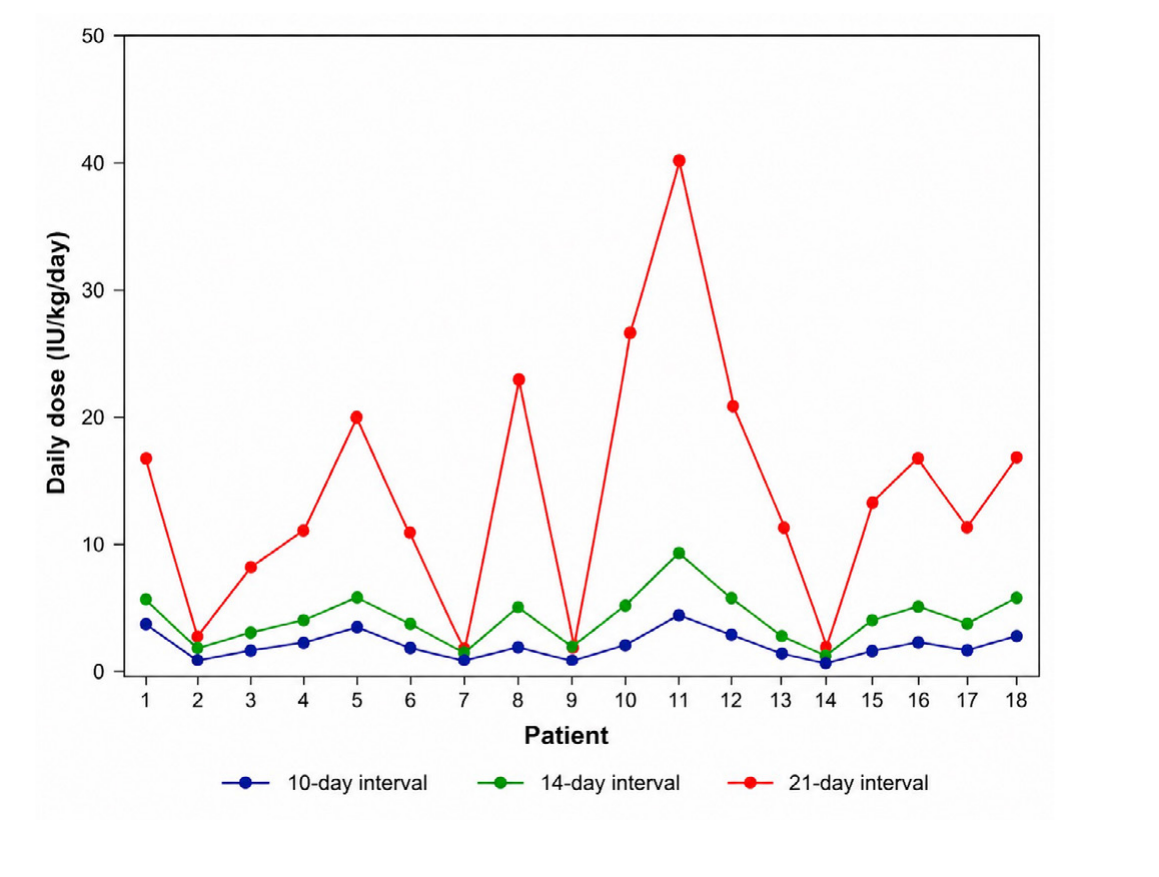
Simulation of individualised dosing requirements, performed with the one-compartment model, showed that the dose needed to maintain target trough levels varied markedly with both the dosing interval and the chosen Cmin. For a target of 3 IU/dL, daily dose requirements were modest with 10-day intervals but increased progressively when the interval was extended to 14 or 21 days, with some patients requiring >20 IU/kg/day at the longest intervals (Figure 1). When the target trough was increased to 5 IU/dL, dose requirements rose substantially across all intervals, in some cases exceeding 40–50 IU/kg/day at 21 days (Figure 2).
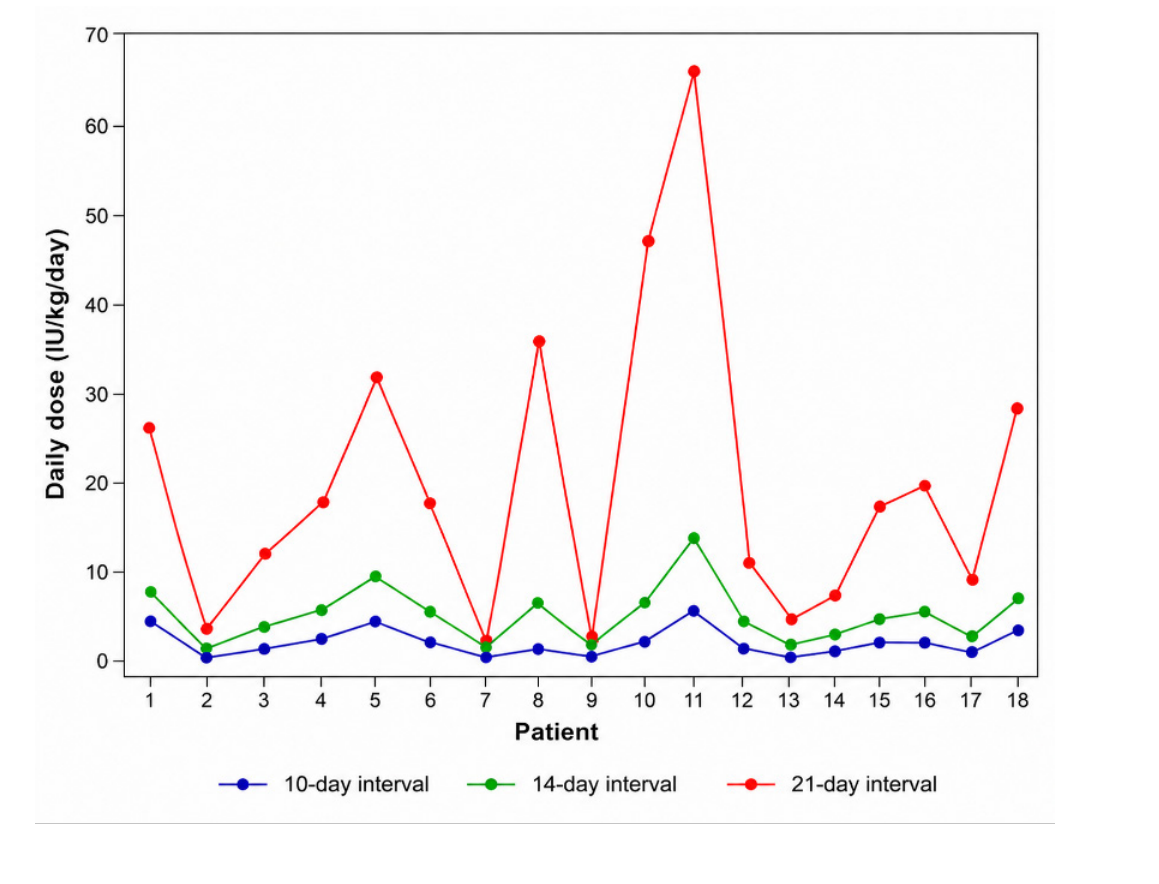
When expressed as mean daily dose (Table 3), maintaining a Cmin of 3 IU/dL required 2.59, 4.27, and 12.93 IU/kg/day at 10-, 14-, and 21-day intervals, respectively (95% CI ±0.26, ±1.04, and ±2.32). For a Cmin of 5 IU/dL, the corresponding means were 4.32, 7.12, and 21.55 IU/kg/day (95% CI ±0.43, ±0.59, and ±3.87). These values were mirrored when expressed as dose per infusion (Table 4), where widening the interval was associated with steep increases in the amount administered (e.g., mean 25.9/43.2 IU/kg at 10 days vs. 271.5/452.5 IU/kg at 21 days for Cmin 3/5 IU/dL). As expected for linear kinetics, raising the trough target from 3 to 5 IU/dL required 1.67-fold increase in dose across intervals (i.e., +67% higher on average).
Table 3. Estimated dosing schedule (IU/kg/day) for patients included in the study, according to target Cmin (3 or 5 IU/dL) for different dosing intervals (10, 14 and 21 days)
| Case/parameter | Regimen C3–C5 (10 days) | Regimen C3–C5 (14 days) | Regimen C3–C5 (21 days) |
|---|---|---|---|
| 1 | 4.43–7.39 | 6.82–11.37 | 17.44–29.07 |
| 2 | 1.01–1.69 | 1.42–2.36 | 3.06–5.10 |
| 3 | 2.18–3.63 | 3.35–5.59 | 8.57–14.29 |
| 4 | 2.78–4.63 | 4.28–7.13 | 10.94–18.23 |
| 5 | 3.97–6.62 | 6.73–11.22 | 20.36–33.94 |
| 6 | 2.13–3.56 | 3.62–6.03 | 10.93–18.22 |
| 7 | 1.10–1.84 | 1.40–2.33 | 2.56–4.27 |
| 8 | 2.59–4.32 | 5.32–8.87 | 22.52–37.54 |
| 9 | 1.90–3.17 | 2.42–4.03 | 4.42–7.37 |
| 10 | 4.09–6.82 | 7.64–12.73 | 27.31–45.52 |
| 11 | 4.65–7.75 | 9.55–15.91 | 40.40–67.34 |
| 12 | 2.30–3.83 | 3.21–5.36 | 6.95–11.58 |
| 13 | 1.44–2.39 | 2.01–3.35 | 4.34–7.23 |
| 14 | 2.38–3.97 | 3.03–5.04 | 5.53–9.21 |
| 15 | 2.18–3.64 | 3.70–6.17 | 11.19–18.64 |
| 16 | 2.41–4.01 | 4.08–6.79 | 12.33–20.54 |
| 17 | 1.77–2.95 | 2.73–4.54 | 6.97–11.61 |
| 18 | 3.30–5.50 | 5.59–9.32 | 16.91–28.18 |
| Mean | 2.59–4.32 | 4.27–7.12 | 12.93–21.55 |
| 95% CI | ±0.26 / ±0.43 | ±1.04 / ±0.59 | ±2.32 / ±3.87 |
| Range | 1.01–6.65 | 2.33–15.91 | 4.27–67.34 |
Table 4. Estimated dosing schedule (IU/kg) for patients included in the study, according to the target Cmin (3 or 5 IU/dL) for different time intervals (10, 14 and 21 days)
| Case/parameter | Regimen C3–C5 (10 days) | Regimen C3–C5 (14 days) | Regimen C3–C5 (21 days) |
|---|---|---|---|
| 1 | 44.31–73.86 | 95.52–159.20 | 366.25–610.41 |
| 2 | 10.12–16.87 | 19.82–33.04 | 64.25–107.09 |
| 3 | 21.78–36.30 | 46.95–78.25 | 180.01–300.02 |
| 4 | 27.79–46.31 | 59.89–99.82 | 229.65–382.75 |
| 5 | 39.74–66.23 | 94.28–157.14 | 427.65–712.75 |
| 6 | 21.34–35.56 | 50.62–84.37 | 229.62–382.69 |
| 7 | 11.02–18.37 | 19.61–32.69 | 53.74–89.57 |
| 8 | 25.92–43.20 | 74.52–124.20 | 472.99–788.32 |
| 9 | 19.05–31.74 | 33.88–56.47 | 92.84–154.73 |
| 10 | 40.93–68.22 | 106.90–178.16 | 573.56–955.94 |
| 11 | 46.50–77.50 | 133.68–222.80 | 848.49–1,414.14 |
| 12 | 22.98–38.30 | 45.00–75.00 | 145.86–243.11 |
| 13 | 14.36–23.93 | 28.11–46.85 | 91.11–151.85 |
| 14 | 23.82–39.70 | 42.37–70.61 | 116.10–193.49 |
| 15 | 21.83–36.38 | 51.79–86.32 | 234.91–391.51 |
| 16 | 24.05–40.09 | 57.07–95.11 | 258.84–431.40 |
| 17 | 17.71–29.51 | 38.17–63.61 | 146.34–243.90 |
| 18 | 32.99–54.98 | 78.27–130.45 | 355.01–591.68 |
| Mean | 25.90–43.17 | 59.80–99.67 | 271.51–452.52 |
| 95% CI | (±2.57) (±4.29) | (±7.43) (±12.39) | (±48.81) (±81.34) |
| Range | (10.12–46.50) (16.87–77.50) | (19.61–133.68) (32.69–222.80) | (53.74–848.49) (89.57–1,414.14) |
The clinical trade-offs between dosing interval and treatment intensity are reflected in the simulated dosing requirements shown in Tables 3 and 4. Extending the interval from 10 to 14 days increased the mean daily dose requirement of 58.9%, whereas extending to 21 days required an increase of 352.5%, while the annual number of infusions decreased from 36.5 to 26.0 and 17.4, respectively. Inter-individual variability remained considerable across all scenarios, widening notably at 21 days, which underscores the need to individualise decisions according to each patient’s PK profile and clinical goals.
Together, these simulations illustrate that while higher trough levels and extended dosing intervals can be achieved with rFIX-FP, they come at the expense of markedly greater dose requirements. The one-compartment model provides clinically coherent estimates that mirror expected linear PK behaviour, thereby offering a practical tool for individualising prophylactic strategies in patients with severe haemophilia B.
This multicentre, real-world study compared PK estimates of rFIX-FP obtained through a classical one-compartment model and the population-based WAPPS model. The one-compartment model produced clearance and half-life values more consistent with those reported in pivotal trials and the product label, whereas WAPPS-Hemo tended to overestimate terminal half-life and underestimate clearance. Simulation analyses based on the one-compartment model further demonstrated the linear PK profile of rFIX-FP, showing predictable relationships between trough concentration targets, dosing interval, and required dose intensity.
One-compartment model estimation of mean half-life (88 h) and clearance (0.93 mL/h/kg) closely matched the values reported in pivotal clinical trials of rFIX-FP, where the mean terminal half-life was 90–104 h and clearance ranged from 0.75 to 0.90 mL/h/kg [1,2]. In contrast, WAPPS yielded longer half-lives (~139 h) and markedly lower clearance (~0.15 mL/h/kg), deviating from reference data [10]. This discrepancy may be related to structural assumptions of the population model, treatment of distribution phases, and the sparse sampling schedule typical of routine practice. Escobar et al. reviewed data from the PROLONG-9FP program and real-world cohorts, confirming the robustness of rFIX-FP PK across populations and highlighting extended half-life and consistent incremental recovery [11]. Similarly, Santagostino emphasised the rationale behind albumin fusion and demonstrated improved PK profiles compared to standard FIX concentrates [12]. Zhang et al. described a population PK model that incorporated sparse sampling and identified interindividual variability in clearance and half-life [13]. Long-term prophylaxis studies, such as the extension analysis by Mancuso et al., showed that intervals up to 21 days are feasible in selected adults, with low annualised bleeding rates and stable trough levels [14]. Our simulations support these findings in principle but also reveal that extending the interval requires disproportionately higher doses (+59% for 14 days, +352% for 21 days compared with 10-day regimens). Case-based reports, such as Kotowski et al. describing PK in renal impairment [15], illustrate how individual factors may affect clearance and half-life, underscoring the importance of individualised assessments.
Limitations of this study include the relatively small sample size (n=18), heterogeneity of the cohort (children and adults), and sparse sampling design. The one-compartment model also assumes uniform distribution and linear elimination, which may oversimplify FIX disposition in some patients. Nonetheless, strengths include the multicentre design, real-world setting, and direct head-to-head comparison of two modelling strategies in the same cohort, providing clinically relevant insights.
Although the one-compartment model yielded pharmacokinetic estimates that were more consistent with pivotal studies and regulatory data, it should not be regarded as a definitive reference method. Simplification of the distribution phase may theoretically lead to underestimation of the true terminal half-life in some patients. Nevertheless, the close agreement between the one-compartment estimates and values reported in pivotal trials and the product label suggests that this approach provides a pragmatic and clinically conservative framework for individualised prophylaxis with rFIX-FP in routine practice.
In summary, simplified PK modelling may represent a pragmatic and reliable tool to individualise prophylaxis in patients with severe haemophilia B, particularly in centres without access to advanced Bayesian platforms.
The practical implication of our findings is that the one-compartment model, despite its simplicity, may provide robust and clinically reliable PK estimates in centres without access to advanced Bayesian tools. Conversely, reliance on WAPPS without critical appraisal could risk under dosing if clearance is underestimated. Simulations highlight the non-linear clinical burden of extending intervals or increasing trough targets, informing shared decision-making with patients regarding efficacy, adherence, and cost-effectiveness.
Future research should validate these findings in larger, diverse cohorts, include other extended half-life FIX products for comparison, and explore hybrid strategies combining Bayesian forecasting with simplified PK models. Cost-effectiveness analyses of different trough targets and intervals are also warranted.
This real-world study compared pharmacokinetic estimates of rFIX-FP obtained with a classical one-compartment model and the WAPPS-Hemo population-based model. The one-compartment approach yielded clearance and half-life values more consistent with pivotal clinical trial data and the product label, whereas WAPPS-Hemo tended to overestimate half-life and underestimate clearance. Simulations based on the one-compartment model confirmed the predictable linear pharmacokinetics of rFIX-FP and illustrated the clinical trade-offs between higher trough targets, extended dosing intervals, and increased dose requirements.
The authors declare that they have participated in educational activities, scientific meetings, and advisory boards sponsored by CSL Behring, Sobi, Pfizer, Octapharma, Novo Nordisk, and Takeda. None of these companies had any role in the design, analysis, or interpretation of the data presented in this study.
The data that support the findings of this study are available on request from the corresponding author. The data are not publicly available due to privacy or ethical restrictions.
Informed consent was obtained from the participants in the study reported in this paper.
None.
Olga Benítez Hidalgo – https://orcid.org/0000-0002-2883-9049
Juan Carlos Juárez Giménez – https://orcid.org/0000-0001-5859-986X
Cristina Sierra Aisa – https://orcid.org/0000-0001-7328-8955
José Antonio Romero Garrido – https://orcid.org/0000-0002-3635-2230
Sara González Pineiro – https://orcid.org/0009-0001-9999-1144
José Bruno Montoro Ronsano – https://orcid.org/0000-0003-4390-2189
Benítez Hidalgo O, Juárez Giménez JC, Sierra Aisa C, Romero Garrido JA, González Pineiro S, Montoro Ronsano JB. Real-world pharmacokinetics of albutrepenonacog alfa (rFIX-FP) in haemophilia B: comparison of population-based and one-compartment models. Bleeding Dis Care Pract 2026; 13(1): 14–23. https://doi.org/10.17225/bdcp-2026-0003
This is an Open Access article distributed under the terms of the Creative Commons Attribution-NonCommercial-NoDerivs 4.0 International License (https://creativecommons.org/licenses/by-nc-nd/4.0/deed.en) which permits use and distribution in any medium, provided the original work is properly cited, the use is non-commercial, and no modifications or adaptations are made. Copyright is retained by the authors.
Authors ©2026: Olga Benítez Hidalgo, Juan Carlos Juárez Giménez, Cristina Sierra Aisa, José Antonio Romero Garrido, Sara González Pineiro, José Bruno Montoro Ronsano. Published by Haemnet Ltd. eISSN: 2978-4204. Journal Contact: publishing@haemnet.com